The Defender 110 Double Cab: Why It Is Hard to Find and Worth Restoring
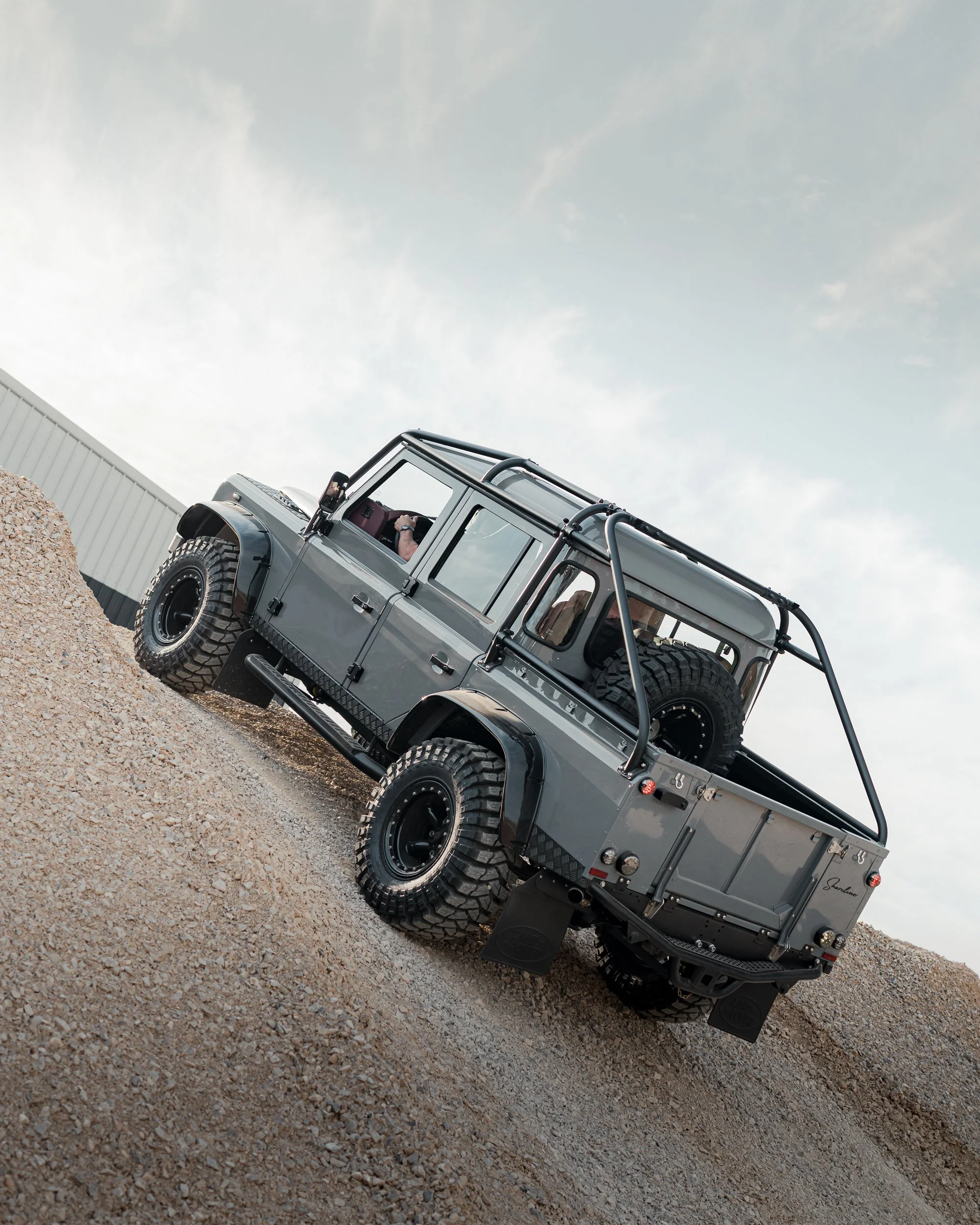
Among the different body shapes of the classic Land Rover Defender, one stands out as the most versatile and arguably the best looking. The Defender 110 Double Cab. Five seats for the family, a separate pickup bed for the gear. It is the shape made famous by the James Bond film Spectre, and it is one of the hardest Defenders to find in good condition.
If you have tried to source one, you already know. Good Double Cabs are rare. They are getting rarer. And the ones that do come up are almost never in a condition you would want to drive without serious work.
Here is why that is the case, and what a proper Defender restoration actually involves when the starting point is a Double Cab.
Why the 110 Double Cab is so difficult to find
The Defender 110 Double Cab was never produced in the same numbers as the standard Station Wagon. Land Rover built fewer of them, and the ones they did build went to a very specific buyer.
They were bought to work
Unlike Station Wagons, which were often bought by families or estates, the Double Cab was almost exclusively sold as a commercial vehicle. Farmers, builders, utility companies. These trucks hauled heavy loads, towed trailers, and spent their working lives covered in mud. Finding a low-mileage Defender 110 Double Cab is almost impossible because they were rarely treated gently.
The chassis takes the punishment
Because of the weight they carried and the way they were used, the original steel chassis on most Double Cabs has suffered. Stress combined with corrosion means many original frames are bent, weakened, or compromised beyond repair. This is the single biggest issue with the Double Cab as a starting platform for a classic Defender restoration.
Collectors are holding on to the good ones
Now that the Double Cab has become a style icon, the few well-preserved examples that exist are being held by collectors. Supply is going down and prices are going up. You can still find them, but finding one that is worth building from is a different thing entirely.
You cannot buy a 110 Double Cab and drive it as-is. The good ones need work. The rough ones need a ground-up rebuild. There is no shortcut.
How Shoreline builds a Double Cab
The Defender 110 Double Cab is one of our favorite platforms to build. But we approach it the same way we approach every Shoreline build. From the ground up, with a standard that does not leave room for shortcuts.
The chassis comes first
We do not patch Double Cab frames. Because of the lives these trucks have lived, we almost always lift the body off the original chassis and install a brand new, hot-dipped galvanized replacement. This is not optional. It is the only way to ensure the vehicle sits straight, drives properly, and will not corrode again. A Defender built on a compromised chassis is a problem waiting to happen, no matter how good the rest of the build is.
Two directions for the build
The Double Cab is a versatile platform. It can go in very different directions depending on how you want to use it.
The Villain route. Painted in Beluga Black or Bonatti Grey, fitted with a Safety Devices external roll cage and oversized tires. It looks purposeful and aggressive. A wide-body Defender 110 pickup that turns heads.
The Beach route. Painted in Arles Blue or Pastel Green with a canvas rear canopy. The ultimate coastal truck. You can throw wet wetsuits and sandy dogs in the back without touching the leather interior up front. It is the most relaxed custom Defender we build.
Engine and drivetrain
The original engines in most working Double Cabs were underpowered for modern road use. The 110 is a heavy vehicle and it needs the right drivetrain to match. Depending on the build, we offer rebuilt and uprated original engines, high-performance diesel packages, or a full LS3 V8 conversion. The LS3 gives the Double Cab the torque it needs for highway driving and the reliability to back it up day after day. Suspension, brakes, axles, and differentials are all rebuilt or replaced to match the engine and how the car will be used.
Interior and finish
The Double Cab cabin is built to the same standard as every Shoreline Defender. Hand-stitched leather, properly finished dashboard, modern gauges, climate control, premium audio. A luxury Defender interior that makes the truck comfortable to live with, not just look at. The rear bed stays utilitarian or gets finished depending on your preference. Some clients want teak decking. Others want a spray-in liner. Both work.
Why the Double Cab is worth the effort
We often recommend the Double Cab to clients who are choosing between a Defender 90 and a Defender 110 Station Wagon. It sits between the two in a way that works for people who want the best of both.
It seats five comfortably. You can carry the family or a few friends without feeling like you are in a work truck. The separate rear bed keeps the cabin clean. Sandy gear, muddy boots, surfboards, luggage. None of it touches the interior. And on the road, nothing looks quite as purposeful as a lifted Defender 110 Double Cab. It has a presence that the Station Wagon and the 90 do not.
When done properly, it is perhaps the most rewarding classic Land Rover Defender to own. A vintage Land Rover Defender with genuine utility, rebuilt to a modern standard, and finished to a level where it is as comfortable as it is capable.
The 12-month warranty on every Shoreline build applies to the Double Cab the same way it applies to everything we produce. It is a reflection of the standard the work is done to, not a sales pitch.
The right starting point
The Defender 110 Double Cab is a rare vehicle. It is difficult to source and difficult to restore correctly. That is exactly why a ground-up Defender build is the right approach. You do not try to save a worn-out truck. You strip it back, replace what needs replacing, rebuild what can be rebuilt, and put it together properly.
That is what Shoreline does. Every Double Cab we produce goes through our nine-stage build process. Chassis, drivetrain, body, interior, testing. A 24-hour systems inspection and a 500-mile road test before the car leaves the workshop. Weekly build photos and updates through our online tracking portal. The same process, the same standard, every time.
If the Double Cab is the Defender you have been looking at, get in touch. We will talk through the spec, the timeline, and what is involved. We will design a build around you.