

The Land Rover Defender in 2026: New Model vs Classic Build
If you are looking at a Land Rover Defender in 2026, you have two very different options. The new Defender from Jaguar Land Rover, which you can buy at a dealership today, or a classic Defender that has been restored or custom-built by a specialist. They share a name and a general idea. Almost everything else is different.
This guide covers what the 2026 Land Rover Defender offers, what it costs, and why a growing number of buyers are choosing to build a classic instead.
The short answer
The 2026 Land Rover Defender is a modern luxury SUV starting at $65,350. It is comfortable, capable, and full of technology. The classic Defender is a bespoke vehicle built to your specification from a vehicle that is no longer in production. One is a purchase. The other is a commission.
The 2026 Land Rover Defender: what you get
The current Defender is built by Jaguar Land Rover and has been on sale since 2020. It is a modern SUV on an aluminum monocoque platform, available in three body styles: the two-door Defender 90, the four-door Defender 110, and the extended-wheelbase Defender 130.
Models and pricing
The 2026 Land Rover Defender 110 starts at $65,350 for the S trim. The range runs through X-Dynamic SE, X-Dynamic HSE, X, V8, and up to the OCTA Black at $170,550. The two-door Defender 90 is priced similarly, and the three-row Defender 130 sits at the higher end of the range.
For most buyers, the Defender 110 in X-Dynamic SE or X trim represents the balance point between capability and value. The X adds adaptive air suspension, expanded terrain modes, heated and ventilated seats, and additional ground clearance.
Engines and performance
The 2026 Defender offers four engine options. A turbocharged 2.0-liter four-cylinder producing 296 horsepower (P300). A turbocharged 3.0-liter inline-six producing 395 horsepower (P400), which is the most popular choice. A supercharged 5.0-liter V8 producing 525 horsepower. And the range-topping OCTA with a BMW-sourced 4.4-liter twin-turbo V8 producing 626 horsepower.
All models come with an eight-speed automatic transmission and permanent all-wheel drive. The P400 inline-six is the sweet spot for most buyers. It offers strong performance, reasonable fuel economy at around 18 to 22 mpg, and is significantly less expensive than the V8 or OCTA models.
Technology and safety
The 2026 Defender comes with a 13.1-inch touchscreen, Apple CarPlay, Android Auto, navigation, a Meridian audio system, wireless charging, and satellite radio as standard. Higher trims add a surround-view camera, head-up display, and upgraded audio.
Safety equipment includes forward collision warning, automatic emergency braking, adaptive cruise control, blind spot monitoring, lane keep assist, and a surround-view camera. The Defender earned a five-star rating from Euro NCAP.
The new Land Rover Defender is, by any modern measure, a well-equipped and capable luxury SUV. It does what it is designed to do very well.

How safe is the new Land Rover Defender?
The 2026 Defender has not been crash-tested by NHTSA in the United States, but it received a maximum five-star overall rating from Euro NCAP. Standard safety features include automatic emergency braking with pedestrian detection, adaptive cruise control, lane departure warning, blind spot monitoring, rear cross-traffic alert, and a surround-view camera system.
For a vehicle of its size and price, the safety specification is comprehensive. This is one area where the new Defender has an advantage that the classic cannot match. The classic Land Rover Defender predates most modern safety systems, and while a custom build can add roll cages, modern seatbelts, and improved braking, it will never have the electronic safety suite of a 2026 vehicle.
Why some buyers choose the classic instead
The 2026 Defender is a good vehicle. It is comfortable, capable, and available now. So why are people spending as much, or more, to commission a classic Land Rover Defender build?
The answer is not rational in the way a spec sheet is rational. It is about what the vehicle feels like, what it looks like, and what it means to the person who owns it.
It is not mass-produced
A new Defender is built on a production line in Nitra, Slovakia. Thousands are produced every year. You can walk into a Jaguar Land Rover dealership and order one from a configurator.
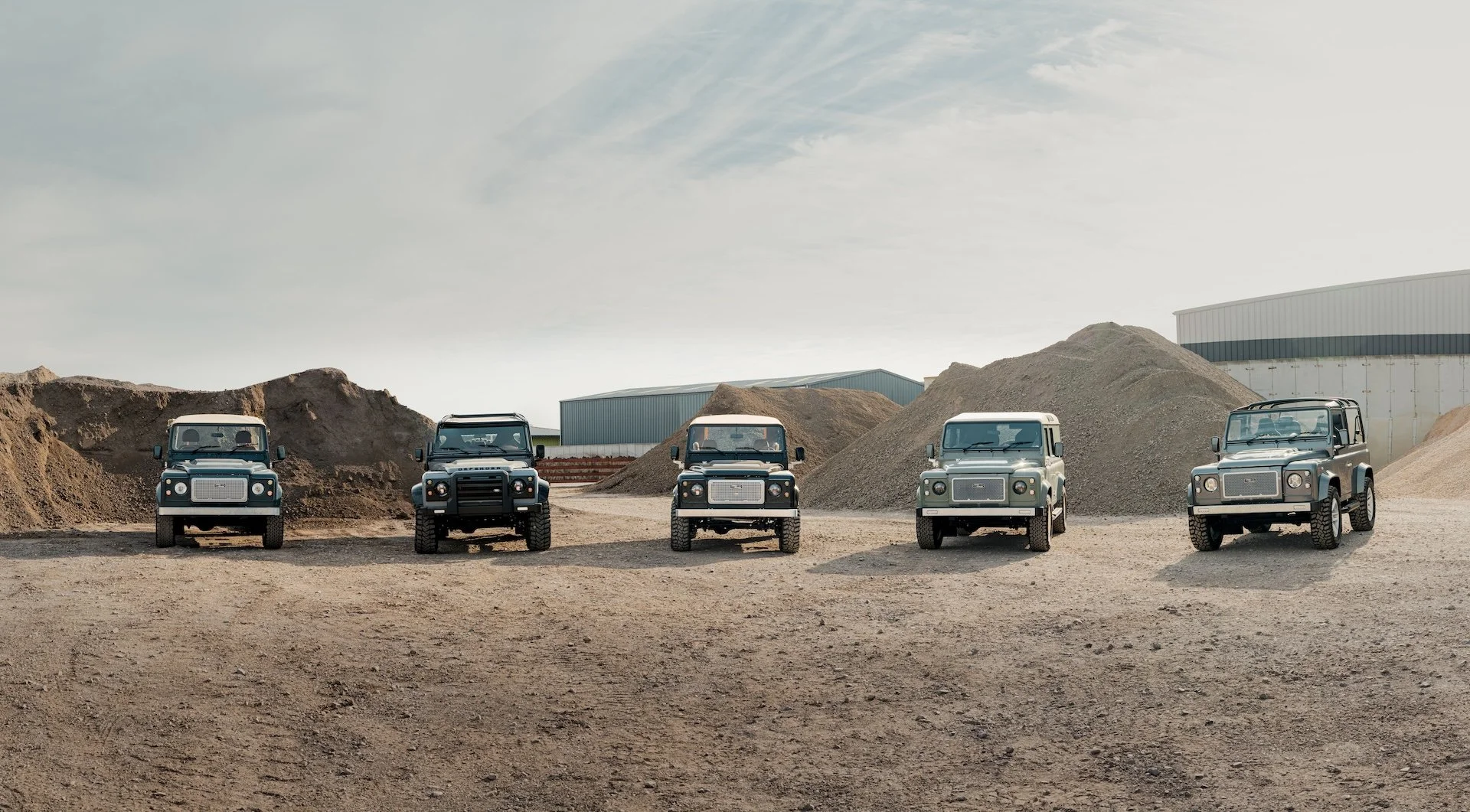
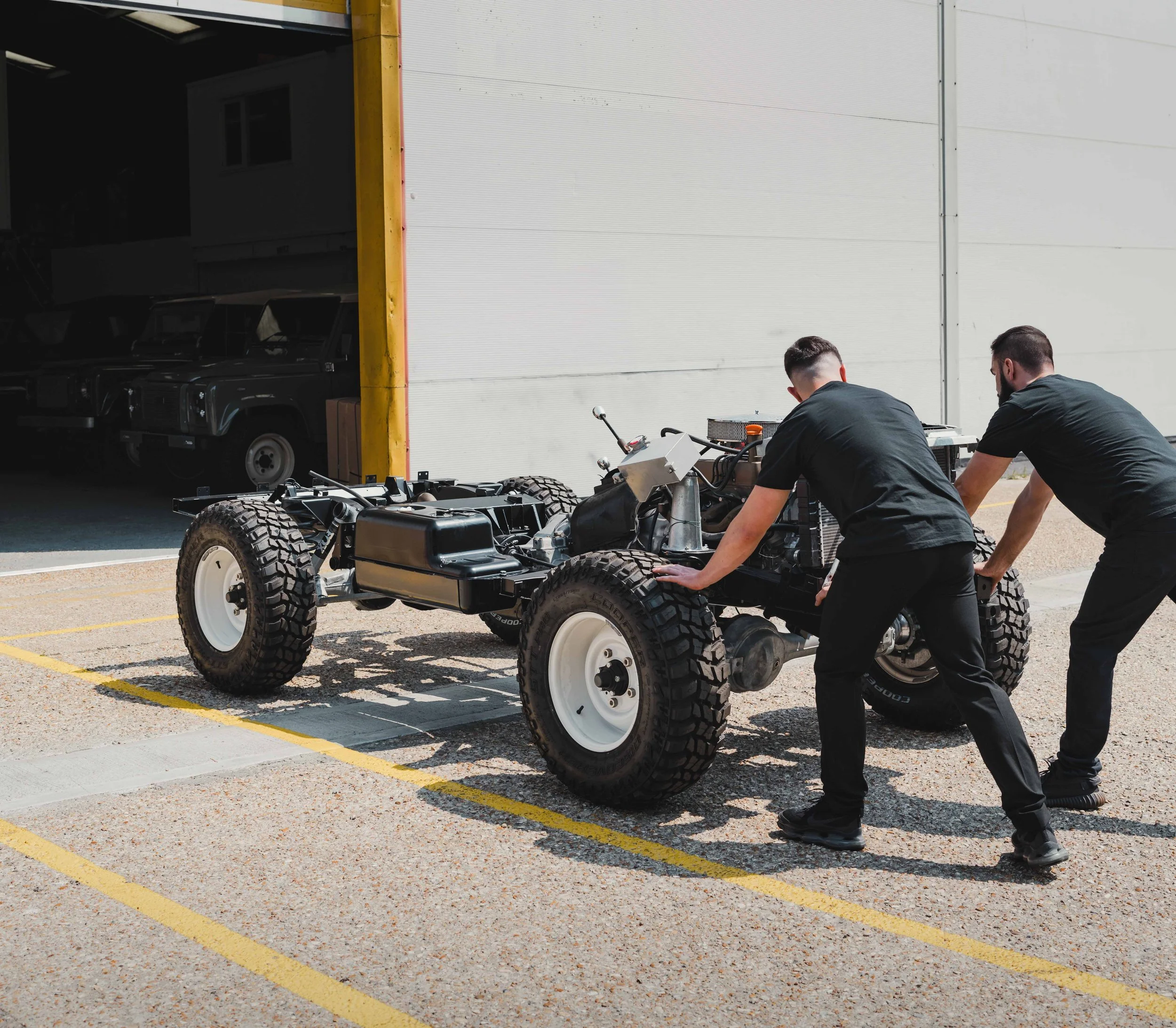
A classic Defender is a vehicle that was built between 1983 and 2016 and no longer exists in production. A custom build starts with a genuine donor, strips it to the bare chassis, and rebuilds it from the ground up to a single specification. Yours. No two are the same. The paint, the interior, the engine, the wheels, the finishing details. All of it is chosen by the owner and built by hand.
It looks different
The new Defender was designed to echo the classic shape, but it is a modern vehicle with rounded panels, plastic cladding, and aerodynamic compromises. It looks like a 2020s SUV with heritage styling cues.
The classic Land Rover Defender looks like nothing else on the road. Flat aluminum panels, exposed rivets, a boxy silhouette that was designed for function and became iconic because of it. On the road, there is no confusing the two. The classic stops people. The new one blends in.
It drives differently
The new Defender drives like a luxury SUV. Smooth, quiet, digitally managed. The suspension adapts automatically. The steering is light. Everything is insulated and refined.
A classic Defender that has been rebuilt with an LS3 V8 and modern suspension still feels mechanical and connected. You feel the road. The steering has weight. The driving experience involves you in a way that a modern vehicle does not. It is not better in an objective sense. It is different in a way that matters to the people who choose it.
It holds value differently
A 2026 Land Rover Defender 110 is expected to depreciate approximately $37,500 over five years. That is normal for a modern luxury SUV.
A classic Land Rover Defender is a finite-supply vehicle. The market has shown consistent value growth over the last decade, and properly built vehicles with full documentation hold their value well. A custom Defender with a restored chassis, Range Rover-standard paintwork, and a full build record is treated by the market as a collectible, not a depreciating vehicle.

New Defender vs Classic Defender: the real comparison
Price
The 2026 Defender 110 starts at $65,350 and can exceed $170,000 in OCTA specification. A custom classic Defender build varies depending on the edition, the engine, and the level of specification. The two overlap in price range, which is part of why the comparison comes up so often.
Practicality
The new Defender is more practical as a family vehicle. It seats five to eight depending on the configuration, has modern cargo space, and comes with every convenience feature you would expect. If you need a vehicle that does school runs, road trips, and grocery shopping with no compromise, the new Defender is the more straightforward choice.
A classic Defender is practical in a different way. A Defender 90 seats four. A Defender 110 seats five to seven. The cargo space is smaller. But it is a vehicle built around how you want to use it, not around a market average. If your needs are specific and you want the vehicle to reflect that, the classic build delivers something the configurator does not.
Ownership experience
A new Defender is a dealership experience. You order it, wait for delivery, and service it through the Jaguar Land Rover network. It is straightforward and predictable.
A custom Land Rover Defender is a build experience. You are involved in the design. You choose the materials. You follow the build through weekly updates and photos. When the vehicle is delivered, you know it inside and out because you were part of the process. For clients who value that involvement, it is a fundamentally different kind of ownership.
Classic vs new Defender: old and new, side by side
Most people researching the Land Rover Defender in 2026 end up asking the same question: old Defender or new Defender? Here is how the two compare across the five things that matter most once the novelty wears off. Design, build, driving, ownership, and value.
New Defender. Rounded panels, plastic cladding, and a shape refined for aerodynamics. It echoes the original and fits neatly into modern traffic.
Classic Defender. Flat aluminum panels, exposed rivets, flat glass, and an upright silhouette engineered to be built simply and repaired easily. Nobody styled it to be fashionable, which is exactly why it has not dated.
New Defender. An aluminum monocoque produced in volume in Nitra, Slovakia, with software-managed systems throughout.
Classic Defender. A separate chassis with an aluminum body, built between 1983 and 2016. A Shoreline build strips a genuine donor to the bare chassis and rebuilds every system to one owner's specification.
New Defender. Quiet, smooth, and insulated, with adaptive suspension and light steering. Effortless, as a modern luxury SUV should be.
Classic Defender. Mechanical and connected. With a 6.2-liter LS3 V8 and a six-speed automatic, a rebuilt classic keeps pace with modern traffic, yet you still feel the road and the steering has weight.
New Defender. Order from a configurator, service through the dealer network, and rely on dealer-level diagnostics when something needs attention.
Classic Defender. A commission you are part of from the first conversation, with weekly updates and photos throughout the build, and systems simple enough to understand. Every Shoreline build is backed by a 12-month warranty.
New Defender. Follows the depreciation curve of any modern luxury SUV, losing a significant share of its value in the first few years.
Classic Defender. A finite supply that will never grow. Well-documented, properly engineered builds with a full build record and a known builder have historically held their value well.
Two different engineering philosophies
The deepest difference between the old and new Defender is not the shape. It is the idea behind each vehicle. The new Defender is technology-first: screens, sensors, driver assists, electronic suspension, and software that manages almost everything. It is impressive engineering, and when something goes wrong it usually takes a dealer's diagnostic equipment to find it.
The classic Defender was designed to be understood mechanically. The architecture is simple and the systems are accessible. A Shoreline build adds modern capability where it counts, with modern wiring, upgraded brakes and suspension, and the engine of your choice from our Defender engine options, without turning the truck into a rolling computer. You know what is under the hood, and you can trust it to work. Every stage of that work is laid out in our build process.
Which one is right for you?
The new Defender prioritizes ease. The classic, properly built, prioritizes experience. If you want the latest technology, a factory warranty, and a vehicle you can drive off a dealer lot, buy the new one. If you want a vehicle with presence and character, built around how you actually plan to use it, a classic build is the better answer. If you are still deciding on size, our guide to the Defender 90 vs 110 walks through the differences, and our Defenders for sale shows finished builds that are available now.
Two different vehicles for two different buyers
The 2026 Land Rover Defender from Jaguar Land Rover is a well-engineered modern SUV. It is comfortable, safe, capable, and available now. If you want a new vehicle with a factory warranty, modern technology, and the convenience of a dealership network, it is a strong choice.
A classic Land Rover Defender is for someone who wants something that does not come off a production line. A vehicle with a shape, a character, and a driving experience that no modern SUV can replicate. A vehicle that is built by hand, designed around one owner, and finished to a standard that reflects the person behind the wheel.
Most of our clients at Shoreline have driven the new Defender. Many have owned one. They choose the classic because it offers something the new model does not. Not better. Different. And for them, that difference is what matters.
What Shoreline builds
At Shoreline, we build classic Land Rover Defenders from the ground up across workshops in the UK and Miami. Defender 90s and Defender 110s across four editions: Heritage, Beach, Villain, and Modern. Every vehicle starts from a restored chassis, receives Range Rover-standard paintwork, a hand-built interior, a fully rebuilt or new drivetrain, and is backed by a 12-month warranty.
If you are comparing the new Defender to a classic build, or if you have already decided the classic is what you want, get in touch. We will walk you through the options, the spec, and the timeline.
Frequently asked questions
The 2026 Land Rover Defender 110 starts at $65,350 for the S trim, and the range tops out with the OCTA Black at $170,550. A custom classic Defender is priced by edition and specification. Our Beach edition, for example, starts from $135,000.
The new Defender, on sale since 2020, is a modern luxury SUV built on an aluminum monocoque with advanced electronics. The classic Defender, built from 1983 to 2016, uses a separate chassis, flat aluminum body panels, and simple mechanical systems. A rebuilt classic is a bespoke vehicle; the new model is a production SUV.
Not better. Different. The new Defender is quieter, safer, and more practical as a family vehicle. A properly built classic offers a shape, a driving experience, and a level of personalization that a production SUV cannot match. Most of our clients have driven both.
Production of the classic Land Rover Defender ended in 2016, after a run that began in 1983. No more will be built, which is why every classic Defender build starts from an original donor vehicle.
An original, unrestored Defender is tiring as a daily driver. A classic rebuilt with an LS3 V8, an automatic transmission, upgraded suspension and brakes, and air conditioning is comfortable enough for everyday use and keeps pace with modern traffic.
Ready to build yours?
Every Shoreline Defender starts with a conversation. Tell us what you have in mind.
GET IN TOUCH