

Electric Land Rover Defender: A 2026 Guide to EV Conversions
The classic Land Rover Defender was built around diesel engines and manual gearboxes. That is part of its character. But electric powertrains have reached the point where they make real sense in a classic Defender, not as a compromise, but as a genuine alternative to a V8 or a rebuilt diesel.
We build electric Defenders on two systems: the Tesla Model 3 drive unit and the Netgain Hyper9 motor. This guide, updated for 2026, explains where the factory stands on an electric Defender, how a classic Defender EV conversion works, what each system delivers, and how to decide whether electric is right for the way you will use the truck.
The short answer
Land Rover does not currently sell a fully electric Defender, so an electric Land Rover Defender today means a classic Defender converted to battery power. At Shoreline we offer two conversions: a Tesla Model 3 drive unit with up to 300 horsepower, around 5 seconds from 0 to 60 mph and 250 to 300 miles of real-world range, or a Hyper9 motor with around 120 horsepower and around 100 miles of range that keeps the original gearbox and low range.
| System | Power | Range | Drivetrain | Best for |
|---|---|---|---|---|
| Tesla Model 3 drive unit | Up to 300 hp0 to 60 mph in around 5 seconds | 250 to 300 milesReal world, with a large battery bank | Original engine and gearbox removed, single-speed reduction drive to the axles | Highway driving, performance, daily use |
| Netgain Hyper9 | Around 120 hp260 Nm of instant torque | Around 100 miles | Keeps the original gearbox and transfer case, including low range | Town use, short commutes, farm and estate use |
Is there an electric Land Rover Defender?
Not from the factory, at least not yet. The current Defender, launched in 2020, is sold with gasoline and mild-hybrid powertrains, and with diesel and plug-in hybrid options in some markets. Land Rover has talked publicly about electrifying its range, but at the time of writing it has not put a fully electric Defender on sale.
The classic Defender, built until January 2016, was never offered with an electric drivetrain at all. So if you want an electric Defender with the original shape, the aluminum body and the upright driving position, a conversion is the only way to get one. That is what most people searching for an electric Land Rover Defender, or a Tesla Defender, are looking for.
Why electric works in a classic Defender
There are practical reasons. Fuel costs fluctuate. An electric drivetrain has far fewer moving parts than a combustion engine, so there are no oil changes, no fuel filters, no timing belts and no exhaust to maintain. And an electric Defender produces no tailpipe emissions.
But the real reason most clients consider an EV Defender build is the driving experience. An electric motor delivers its full torque from a standstill. There is no turbo lag and no waiting for the engine to come on boost. The acceleration is immediate and smooth. And without a diesel running, the cabin is genuinely quiet. You hear the road, the wind and the conversation. Not the rattle.
An electric conversion keeps the body, the chassis and the presence of a classic Defender. It changes what is underneath, not what it looks like.
The Tesla Model 3 drive unit: the performance option
The most powerful electric option we offer is a mid-mounted Tesla Model 3 drive unit. This is the choice for clients who want serious performance from their custom Defender.
The numbers are significant: up to 300 horsepower, all-wheel drive capability and a 0 to 60 time of around 5 seconds. That is faster than many modern SUVs and considerably faster than any original Defender ever was.
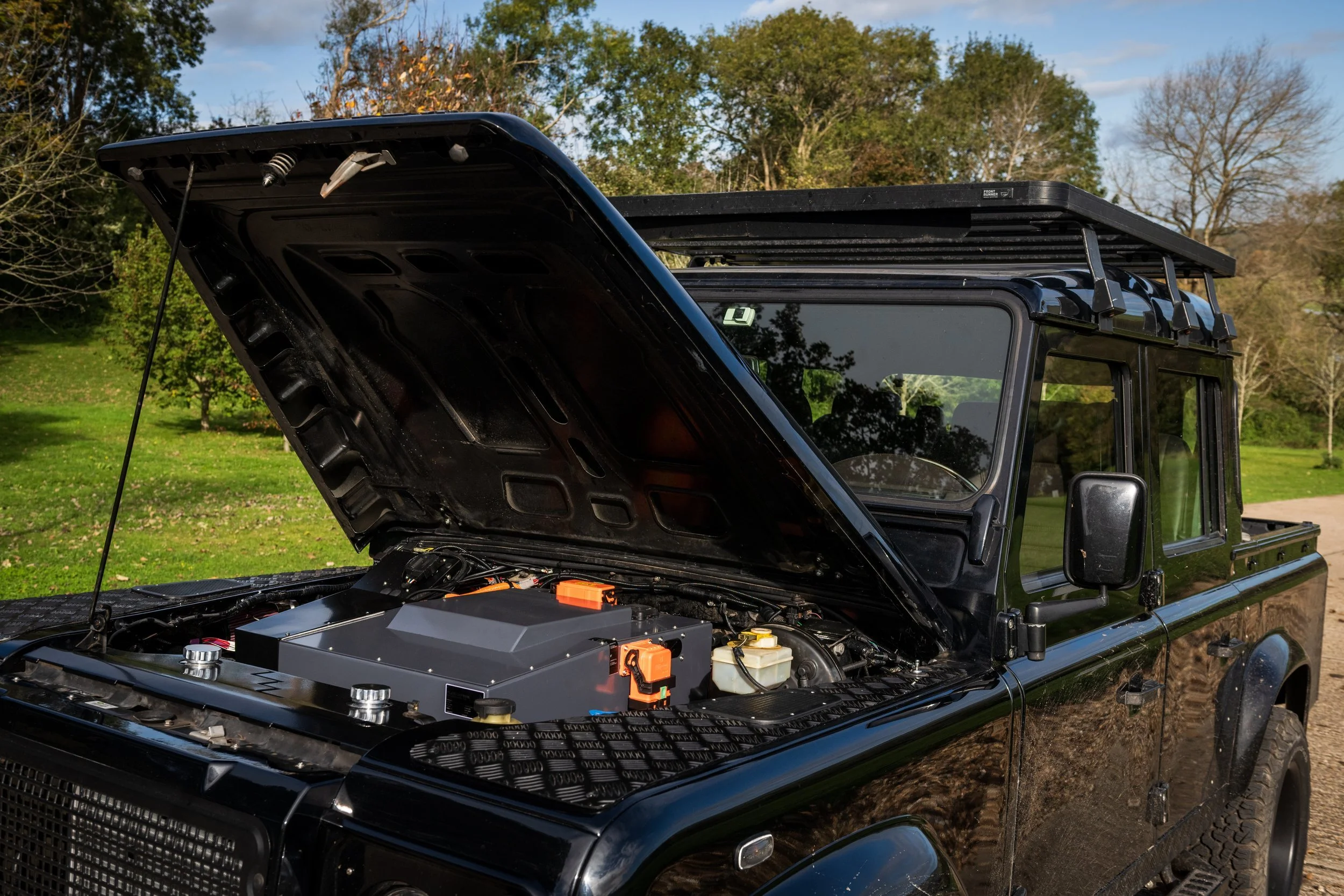
In this configuration, the original engine and gearbox are removed entirely. The Tesla unit is compact and efficient, and power reaches the axles through a specialized reduction box. The engine bay is repurposed for a custom battery pack, and with a large enough battery bank, real-world range sits between 250 and 300 miles depending on driving conditions.
This is the right choice for clients who want a Defender 90 or Defender 110 that drives like a modern performance vehicle. Highway merging, overtaking, daily commuting. None of it needs a second thought.
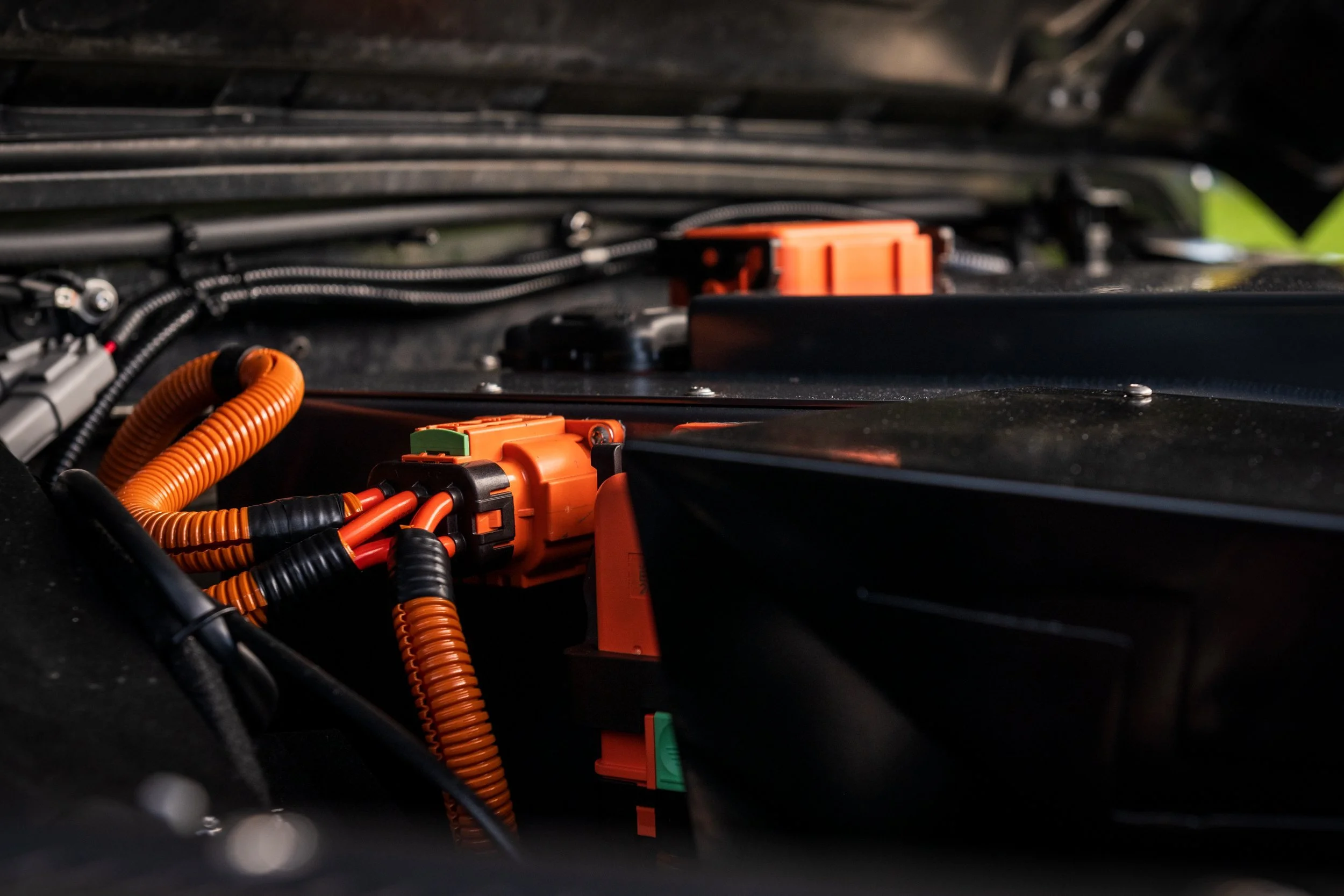
High-voltage cabling in one of our electric Defender conversions.
The Hyper9 motor: the mechanical option
The Hyper9 is a different approach. It delivers around 120 horsepower and 260 Nm of instant torque, which is more modest than the Tesla unit but still enough for comfortable road use.
The key difference is that the Hyper9 keeps the original gearbox and transfer case. You still shift gears, and you still have low-range four-wheel drive. The mechanical connection to the truck stays intact, which matters to clients who value that part of the Defender experience.
Range on a Hyper9 build is around 100 miles, which suits town driving, short commutes, farm use, or clients who do not need long-distance capability from the electric drivetrain. It is a lighter conversion, both in weight and in cost.
What goes into a Shoreline EV conversion
An electric Defender conversion is not just an engine swap. The whole vehicle has to be engineered around the new power delivery and the new weight distribution. A full Shoreline EV build includes:
- A high-voltage battery pack, custom fabricated to fit the engine bay and the rear of the vehicle.
- A Tesla Model 3 drive unit or a Hyper9 motor, depending on the build.
- A digital EV instrument cluster, styled to suit the vintage dashboard.
- A DC to DC converter to power the 12V systems, including lights, radio and accessories.
- Electric power steering.
- An electric brake vacuum pump.
- A high-voltage heater element for instant cabin heat.
- A CCS fast-charging port, mounted behind the original fuel cap location.
- A fully upgraded wiring harness and battery management system.
- Regenerative braking.
The result is a fully electric Defender 90 or Defender 110 that looks like a classic Land Rover on the outside and drives like a modern vehicle underneath. Every system is engineered to work together, not bolted on as an afterthought.
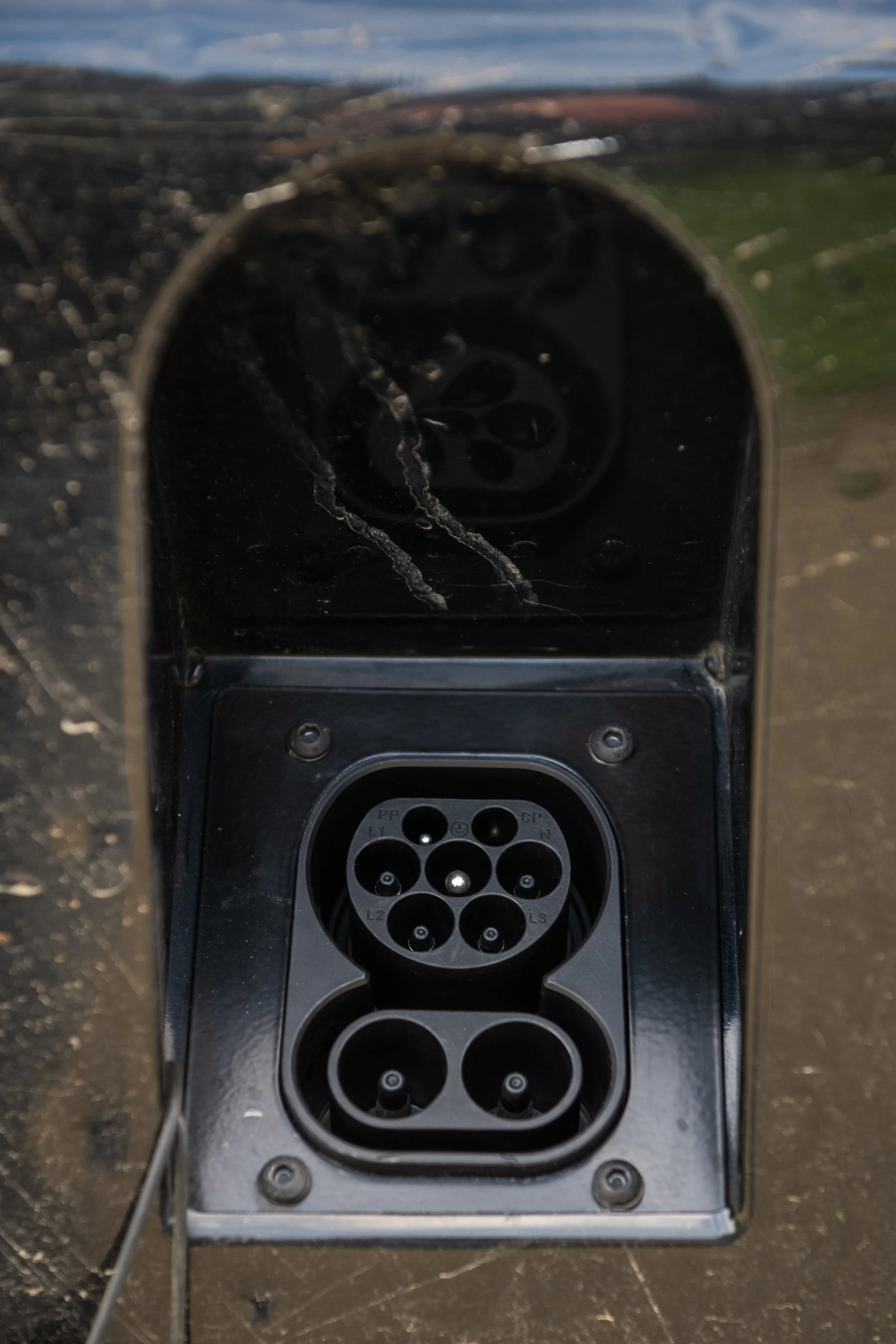
The charging port sits behind the original fuel cap location, so the body stays unchanged.
The conversion starts with the chassis
An EV conversion is only as good as the truck it is built on. Every Shoreline build, electric or not, follows the same build process. We source a genuine donor Defender, strip it to the bare chassis, inspect it, strengthen it and treat it for corrosion before anything goes back on. Axles, differentials and brakes are rebuilt or replaced, suspension is set up for how the truck will be used, and the body is refinished by hand.
Then the drivetrain goes in, the interior is trimmed, and every finished truck completes a 500-mile road test before it leaves our workshop, with a 12-month warranty when it is handed over.
Range, charging and real-world use
The range figures above are real-world estimates, and like any EV, an electric Defender's range depends on how it is driven. A few general points are worth knowing before you choose.
- Speed matters. A classic Defender is tall and square, so it pushes a lot of air. Range is best at town and back-road speeds and drops at sustained highway speeds.
- Weather matters. Batteries are less efficient in cold weather, and running the heater uses energy, so expect less range in winter.
- Tires and weight matter. Big all-terrain tires, roof racks and heavy loads all reduce range, just as they increase fuel use on a gas truck.
- Charging. The CCS port lets the truck use DC fast chargers on longer trips. Most owners do most of their charging at home.
For most clients, the deciding question is simple: how far do you drive in a normal day, and how often do you take long trips? The answer usually points clearly to one system or the other.
Electric, V8 or diesel?
We build Defenders with every powertrain we offer, so we have no reason to push one over another. If you want a quiet, low-maintenance Defender for daily driving, city use or short to medium trips, electric is a strong option. If you want range and performance, the Tesla drive unit delivers both. If you want the mechanical feel of shifting gears with the efficiency of electric power, the Hyper9 keeps that experience alive.
If you want the sound and character of a combustion engine, a rebuilt diesel or an LS3 V8 is the better fit. Our Defender engine options page compares every choice, and our Defender V8 swap guide covers the LS3 in detail. If you are weighing up a used truck against a new build, read our used Land Rover Defender buyer's guide.
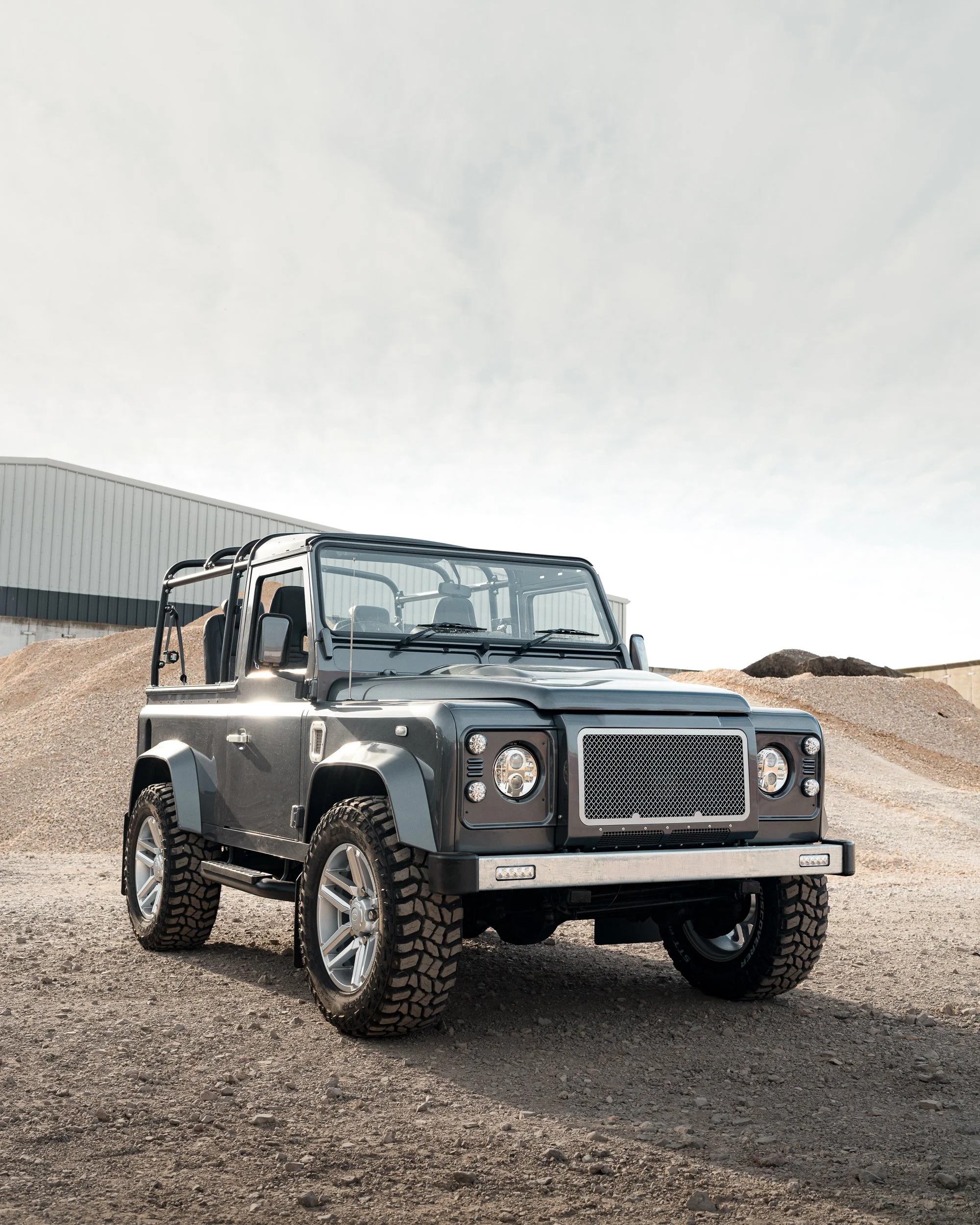
A Shoreline Defender 90 Modern. Electric conversions can be specified on our builds, alongside the LS3 V8, EcoBoost and rebuilt diesels.
The electric conversion can be fitted to either a Defender 90 or a Defender 110. Our Modern edition, with its contemporary finish, is a natural partner for a modern drivetrain, and our Defender 90 vs 110 guide helps you choose the wheelbase.
Frequently asked questions
Is there an electric Land Rover Defender?
Not from the factory at the time of writing. Land Rover sells the current Defender with gasoline, mild-hybrid and, in some markets, diesel and plug-in hybrid powertrains. A fully electric classic Defender is available as a conversion.
Can you convert a Land Rover Defender to electric?
Yes. We convert classic Defender 90s and 110s using either a Tesla Model 3 drive unit or a Hyper9 motor, with a custom battery pack, new wiring, electric power steering, regenerative braking and CCS fast charging.
How far can an electric Defender go on a charge?
A Tesla-powered Shoreline Defender with a large battery bank gives 250 to 300 miles of real-world range. A Hyper9 build gives around 100 miles. Speed, weather, tires and load all affect the figure.
How fast is a Tesla-powered Defender?
With up to 300 horsepower, a Tesla Model 3 drive unit takes a Shoreline Defender from 0 to 60 mph in around 5 seconds.
Does an electric Defender keep four-wheel drive and low range?
A Hyper9 build keeps the original gearbox and transfer case, including low-range four-wheel drive. The Tesla build replaces the gearbox with a reduction drive and has all-wheel drive capability.
How much does an electric Defender conversion cost?
It depends on the system, the battery size, the edition and the rest of the specification. The Hyper9 is the lighter, lower-cost conversion. Get in touch and we will price a build around how you plan to use it.
Considering an electric Defender?
Tell us how you plan to use it. We will talk you through both systems and design a build around you.
GET IN TOUCH