

Land Rover Defender 110: The Classic Long-Wheelbase Guide
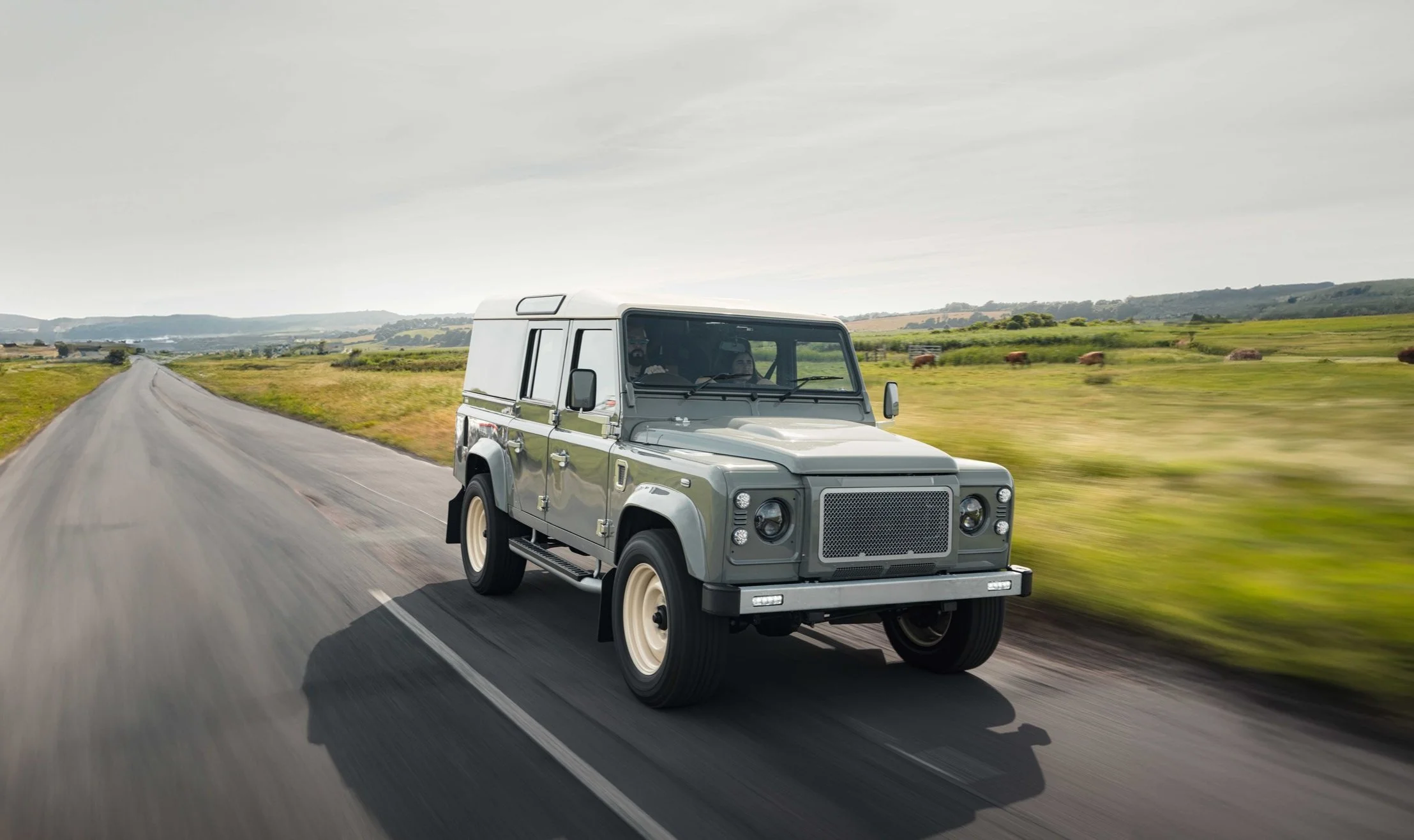
Search for "Land Rover Defender 110" today and most of what comes back is the new one. This guide is about the original: the classic, long-wheelbase Defender 110 that Land Rover built from 1983 to 2016, and the truck most people still picture when they hear the name.
The 110 is the platform we build most often at Shoreline. It is the family all-rounder of the classic range, with four doors, room for five or more, a proper load floor and a ride that settles down on the highway in a way the shorter 90 never quite does. Below is everything we get asked about it: where it came from, every body style, the dimensions, the engines, what to check before you buy one, and how we build ours.
The short answer
The classic Land Rover Defender 110 is the long-wheelbase Defender, named for its 110 in (2,794 mm) wheelbase. It launched as the One Ten in 1983, became the Defender 110 for 1991 and was built until January 2016. It came as a Station Wagon, Utility Wagon, Hard Top, Pick Up, High Capacity Pick Up and Double Cab Pick Up, and a Station Wagon is 188.4 in (4,785 mm) long. It is a different vehicle from the new Defender 110 that went on sale in 2020.
The classic Defender 110 vs the new Defender 110
The name is the same. The vehicles are not. The classic Defender 110 is a body-on-chassis truck: a mild-steel ladder chassis with an aluminum body bolted on top, coil springs, solid axles and permanent four-wheel drive. Every panel can be unbolted, and almost every part can be rebuilt by hand.
The current Defender 110 has been on sale since 2020. It is a modern SUV on an aluminum monocoque platform, with the technology, refinement and electronics you would expect from a new luxury vehicle. It is very good at what it does, but it is a different kind of vehicle. If you want to compare the two in detail, read the Land Rover Defender in 2026: new vs classic.
Everything below refers to the classic 110. When we say Defender 110 in this guide, we mean the original long-wheelbase truck built at Solihull, and the one every Shoreline 110 starts from.
A short history of the Defender 110
The classic Defender 110 did not start life as a Defender. The long-wheelbase One Ten arrived in 1983, a year before the short-wheelbase Ninety. It replaced the leaf-sprung Series III with coil springs and permanent four-wheel drive, and it set the shape that everyone now calls a Defender.
Early One Tens used carried-over 2.25 petrol and diesel engines, followed by a 2.5 diesel from 1984 and a 2.5 petrol from 1985. The 3.5 Rover V8 was offered in the One Ten from the start, and a 2.5 Diesel Turbo joined the range in 1986. None of them was fast. These were trucks built for fields, farms and expeditions, not freeways.
Late in 1990, for the 1991 model year, the One Ten became the Defender 110. The name arrived alongside the 200Tdi, a direct-injection turbodiesel that finally gave the truck enough pull to cruise. The 300Tdi followed in 1994, the five-cylinder Td5 in 1998, and the Ford-sourced Puma diesel in 2007. The last classic Defender left the Solihull line on 29 January 2016.
The 110 also has a small but important American chapter. In 1993 Land Rover sold about 500 NAS Defender 110s new in the US, all with Rover V8 petrol engines. They were the first Defenders sold new in America, and they are rare and collectible today.
| Era | Years | Main engines | What changed |
|---|---|---|---|
| One Ten | 1983 to 1990 | 2.25 and 2.5 petrol, 2.5 diesel, 2.5 Diesel Turbo, 3.5 V8 | Coil springs and permanent four-wheel drive replace the Series layout |
| 200Tdi | 1990 to 1994 | 2.5 turbodiesel107 bhp | Defender 110 name, first direct-injection diesel |
| 300Tdi | 1994 to 1998 | 2.5 turbodiesel111 bhp | R380 gearbox, disc brakes on all four wheels |
| Td5 | 1998 to 2006 | 2.5 five-cylinder122 bhp | Electronic engine management, one-piece rear door from 2002 |
| Puma | 2007 to 2016 | 2.4, then 2.2 Ford diesel122 bhp | Full-width dashboard, six-speed gearbox, forward-facing rear seats |
Every era has its fans. For a closer look at what changed year by year, and how to tell the eras apart by the grille badge, bumper, dashboard and engine, read our vintage Land Rover Defender year-by-year guide.
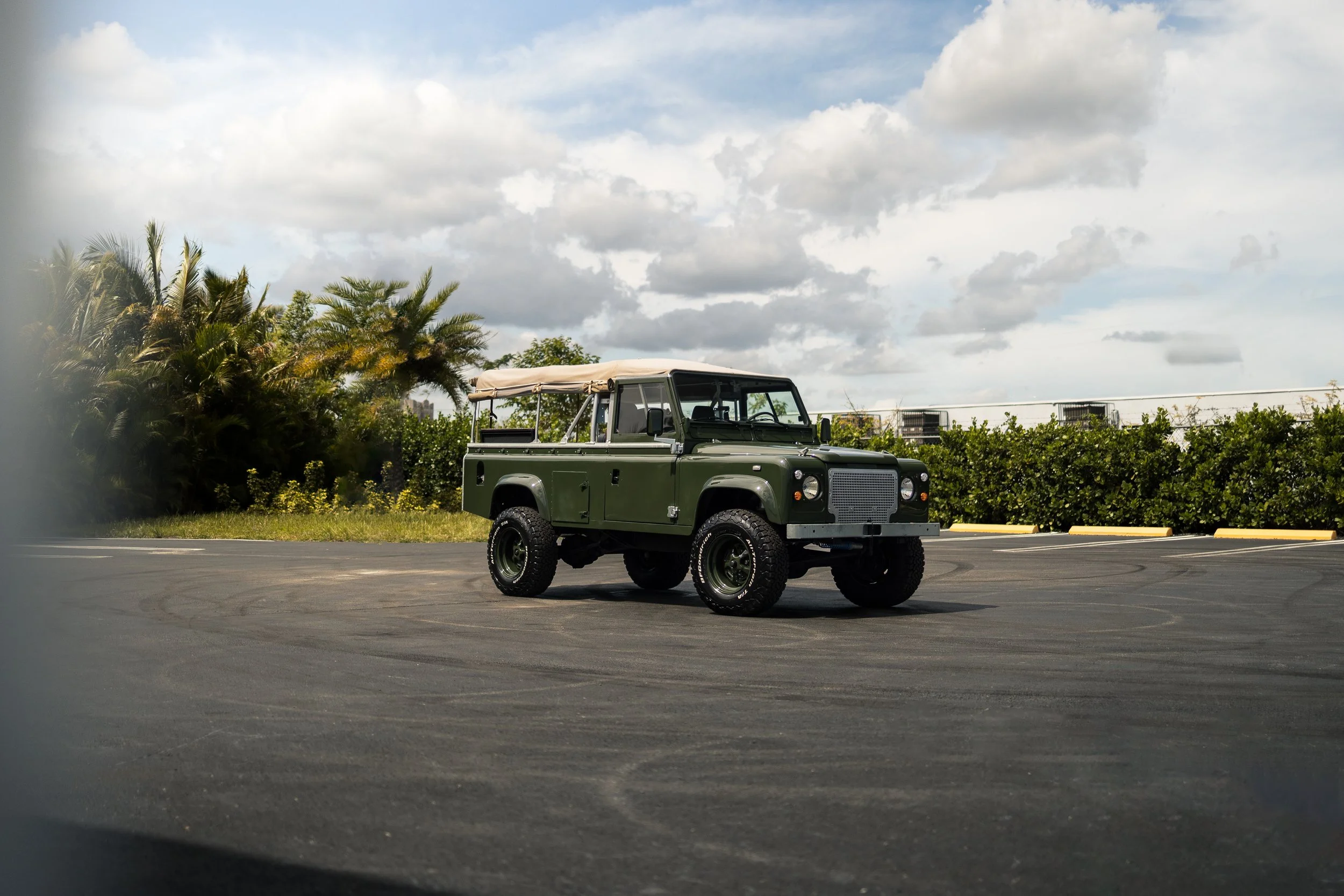
A 1990 Defender 110 soft top, restored through our Restoration Lab in Miami.
Defender 110 body styles
The 110 came in the widest range of bodies of any classic Defender. Each one uses the same 110 in wheelbase, but they suit very different owners.
Station Wagon
The most common 110 and the one most of our clients choose. Four side doors, a rear door carrying the spare wheel, full-height glass all round and seating for five, with room for more in the back. Before 2007, the rear load area typically carried inward-facing benches, which is where the troop carrier nickname comes from. Puma trucks from 2007 switched to forward-facing rear seats, taking the 110 to seven.
Utility Wagon and Hard Top
The Utility Wagon shares the Station Wagon's body, length and load floor, with five seats. The Hard Top is the panel-van version: two seats up front and a long, enclosed load area behind them. Both make excellent starting points for a build because the body is the same length as the Station Wagon.
Soft Top
A full canvas roof over the 110 body, with half-height doors and the whole cabin open to the air when the top comes down. A 110 soft top is less common than a 90 soft top, which makes good ones worth finding. It is the platform for our Defender 110 Beach, and the Heritage, Modern and Villain editions can all be built as soft tops too.
Pick Up and High Capacity Pick Up
Two-seat trucks with an open bed. The standard Pick Up is 180.2 in (4,578 mm) long with a 68.5 in (1,740 mm) load floor. The High Capacity Pick Up is 187.9 in (4,773 mm) long with the longest load floor of any 110, at 78.2 in (1,986 mm).
Double Cab Pick Up
Four doors, five seats and a separate open bed behind the cab. Also called the crew cab or 110 pickup, and made famous by the James Bond film Spectre. Fewer were built than Station Wagons, and most were worked hard as commercial trucks, so good ones are rare. Our Defender 110 Double Cab guide covers why they are hard to find and how we rebuild them.
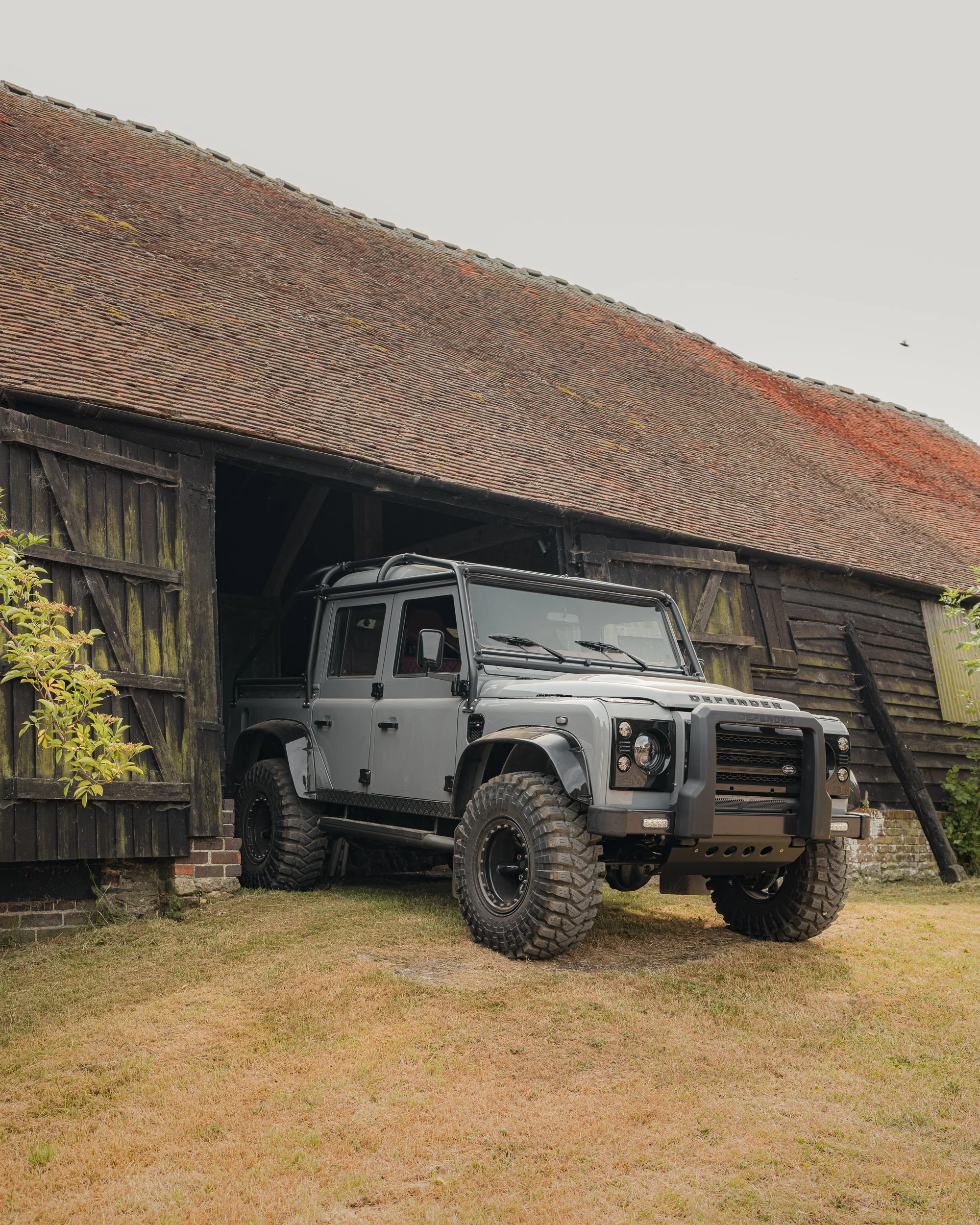
Casino, a Defender 110 Villain Double Cab in Nardo Grey.
Defender 110 dimensions
The classic Defender 110 looks big in photos, but it is narrower than most modern SUVs. The difference between it and the 90 is length, almost all of which goes into seats and load space.
| Defender 110 | Overall length | Seats | Load floor length | Kerb weight, from |
|---|---|---|---|---|
| Station Wagon | 188.4 in4,785 mm | 5, or 7 | 74.8 in1,900 mm | 4,550 lb2,064 kg |
| Utility Wagon | 188.4 in4,785 mm | 5 | 74.8 in1,900 mm | 4,550 lb2,064 kg |
| Hard Top | 188.4 in4,785 mm | 2 | 74.8 in1,900 mm | 4,341 lb1,969 kg |
| Pick Up | 180.2 in4,578 mm | 2 | 68.5 in1,740 mm | 4,235 lb1,921 kg |
| High Capacity Pick Up | 187.9 in4,773 mm | 2 | 78.2 in1,986 mm | 4,281 lb1,942 kg |
| Double Cab Pick Up | 180.2 in4,578 mm | 5 | 40.2 in1,020 mm | 4,511 lb2,046 kg |
A 110 Station Wagon is 79.6 in (2,021 mm) tall and 78.4 in (1,992 mm) wide including the mirrors. It has 9.8 in (250 mm) of ground clearance under the axles, a 19.7 in (500 mm) wading depth and a 48.7 degree approach angle, and it is rated to tow 7,716 lb (3,500 kg) braked. The turning circle is 42 to 47.2 ft (12.8 to 14.4 m) depending on tires.
A standard-height 110 fits through a 7 ft garage door with a few inches to spare, but lifts, larger tires and roof racks add height quickly. Our full Land Rover Defender dimensions guide has every measurement for the 90, 110 and 130, including load space, off-road angles and weights.
Figures are Land Rover's published specifications for the final classic Defender range. A custom build will vary with its tires, suspension, bumpers, roof and equipment.
Seating: five, seven or nine
The 110 is the only classic Defender with real flexibility in seating, and the layout you choose shapes how the truck works every day.
- Five seats. Two front seats, a three-person middle-row bench and a full cargo area behind. The most common layout, and the best balance of people and luggage.
- Seven seats. Load bay seating, either a bench or individual seats, adds two more places in the back. When they are folded away, the cargo area returns to full size.
- Nine seats. The classic troop carrier layout, with benches facing each other in the rear. It carries the most people and works best for shorter trips.
Defender 110 engines
The 110 is heavier than the 90, so the engine matters more. The original diesels were built for torque at low speed, not for holding 75 mph with a full load. That is fine for a farm truck and less fine on a modern interstate.
On a Shoreline 110, every engine is matched to the transmission, cooling, brakes and suspension as one system. These are the options we build with:
- LS3 V8. A 6.2-liter GM V8 producing over 430 horsepower, paired with a six-speed automatic. The most popular choice for a 110 restomod, with the power to cruise comfortably and move a full load. CARB-compliant with the E-ROD package for 50-state registration.
- LT1 V8. Offered across our 110 editions as the California compliant V8 option.
- Ford 2.3L EcoBoost. A turbocharged four-cylinder of around 310 horsepower, sitting between the diesels and the V8 in power and running costs.
- 300 TDi. The most popular classic Defender diesel. We rebuild it with our in-house tuning pack and increase it to 2.8L for more torque. The go-to engine for Heritage builds.
- TD5. A five-cylinder turbodiesel with more mid-range pull than the 300 TDi, rebuilt and tuned with a stage 2 performance package.
- Electric. A Hyper9-based system or a Tesla Model 3 drive unit with up to 300 horsepower, for a near-silent classic 110.
The diesels come with a manual gearbox as standard and an automatic as an option. For the full comparison, see our Defender engine options.
What to look for when buying a classic Defender 110
Most classic 110s are now 25 to 40 years old, and many lived as work vehicles. In original, unrestored form, they are not reliable by modern standards. That is not a design flaw. It is age. These are the checks our team runs on every 110 that comes into the workshop:
- Chassis. The chassis is mild steel and the body is aluminum, and corrosion is common where the two meet. Check the rear crossmember, outriggers, front dumb irons and fuel tank cradle. Deep pitting, flaking steel or soft spots change the cost of everything else.
- Bulkhead and door frames. The bulkhead is where we find hidden rot most often. Look in the footwells, at the base of the A-pillars and around the vents.
- Engine, gearbox and leaks. Start it cold, listen for a smooth idle, watch for heavy smoke and look for oil around the sump, transfer box and axles.
- Suspension, steering and brakes. Check the steering box for play, the springs, shocks and bushings for wear, and the calipers, rotors and brake lines.
- Electrics and water leaks. The original wiring harness is the single most common failure point we see. Damp carpets or a musty smell point to failed seals.
- VIN, title and history. Match the chassis plate to the paperwork. A full service history matters more than mileage.
Double Cabs and High Capacity Pick Ups deserve extra care, because they usually carried heavy loads for most of their lives. Our used Land Rover Defender buyer's guide covers every check in detail, along with the questions to ask about a "restored" truck.
Defender 110 vs Defender 90
The 90 is a three-door, short-wheelbase Defender that seats four. It is lighter, more agile, turns tighter and has the proportions many people picture when they think of a classic Defender. The 110 gives up some of that compactness for genuine usability: more seats, a bigger load area and a more composed ride over long distances.
If the Defender will be your main vehicle, carry a family or cover long highway miles, the 110 is the better choice. If it is a weekend car, a city car or a beach car for two, the 90 makes a strong case. Our Defender 90 vs 110 guide compares them side by side.
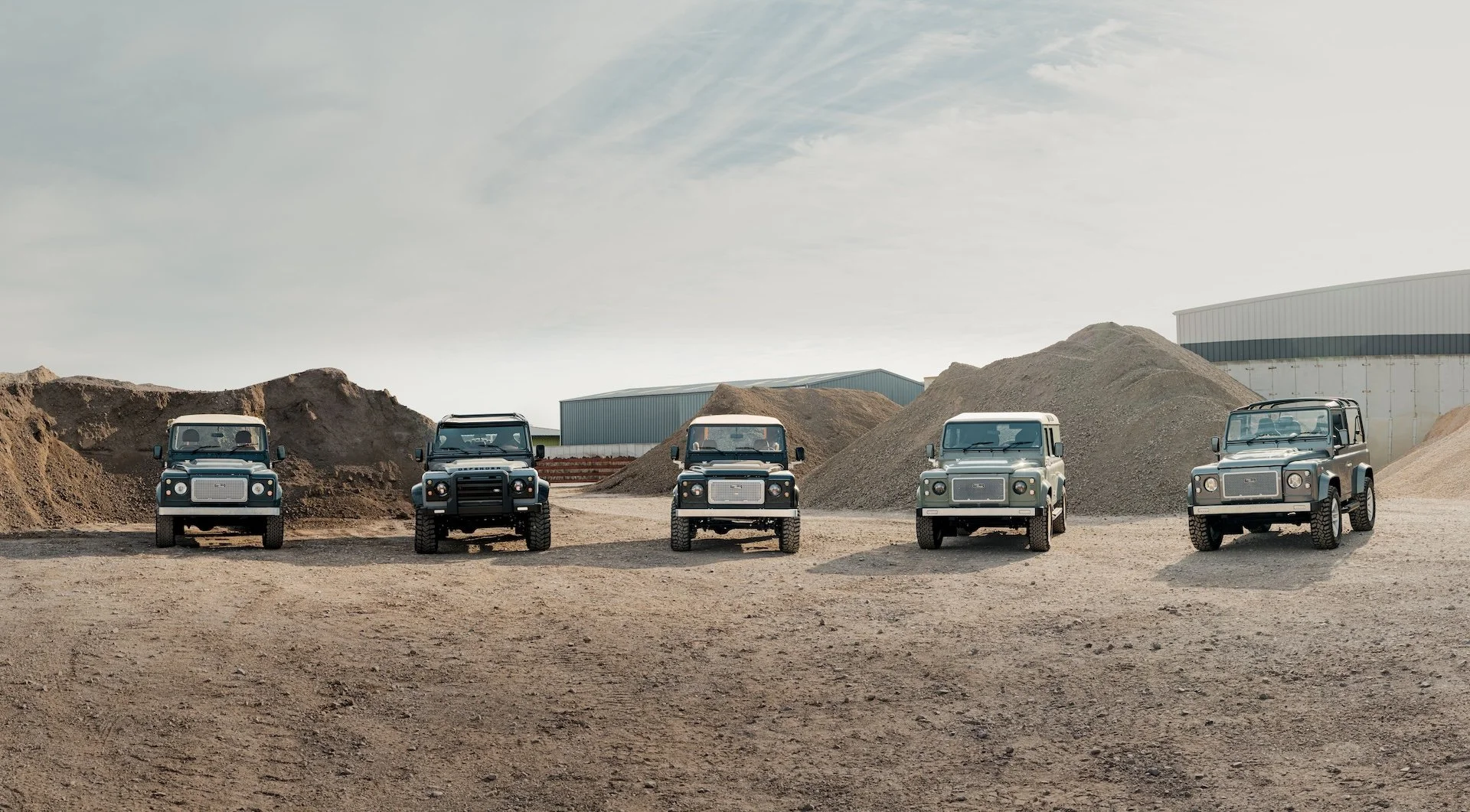
Defender 90 and 110 builds side by side at Shoreline.
Shoreline Defender 110 editions
Every Shoreline 110 starts from one of four editions. Each is a clear starting point, five doors on the long-wheelbase setup with the Shoreline Dynamic Ride or off-road suspension and steering upgrade, and each can be tailored from there. All four are available in gas or diesel, with a manual or automatic gearbox.
The open-air 110. A full-length canvas soft top on an extended heavy-duty frame, half-height doors, a teak deck in the load bay and leather throughout. From $135,000. See the Defender 110 Beach.
The classic silhouette kept period-correct, with deep dish steel wheels, a heritage grille, heated leather seats and Apple CarPlay quietly built in. From $140,000. See the Defender 110 Heritage.
Classic soul with a contemporary finish: XTR2 alloys, smoked LED lighting, Recaro heated seats, a 60:40 middle row and our big brake upgrade. From $150,000. See the Defender 110 Modern.
Our most aggressive 110, inspired by the Spectre Defender: wide arches, lifted suspension, beadlock wheels on 35 in tires and heated sports buckets. From $200,000. See the Defender 110 Villain.
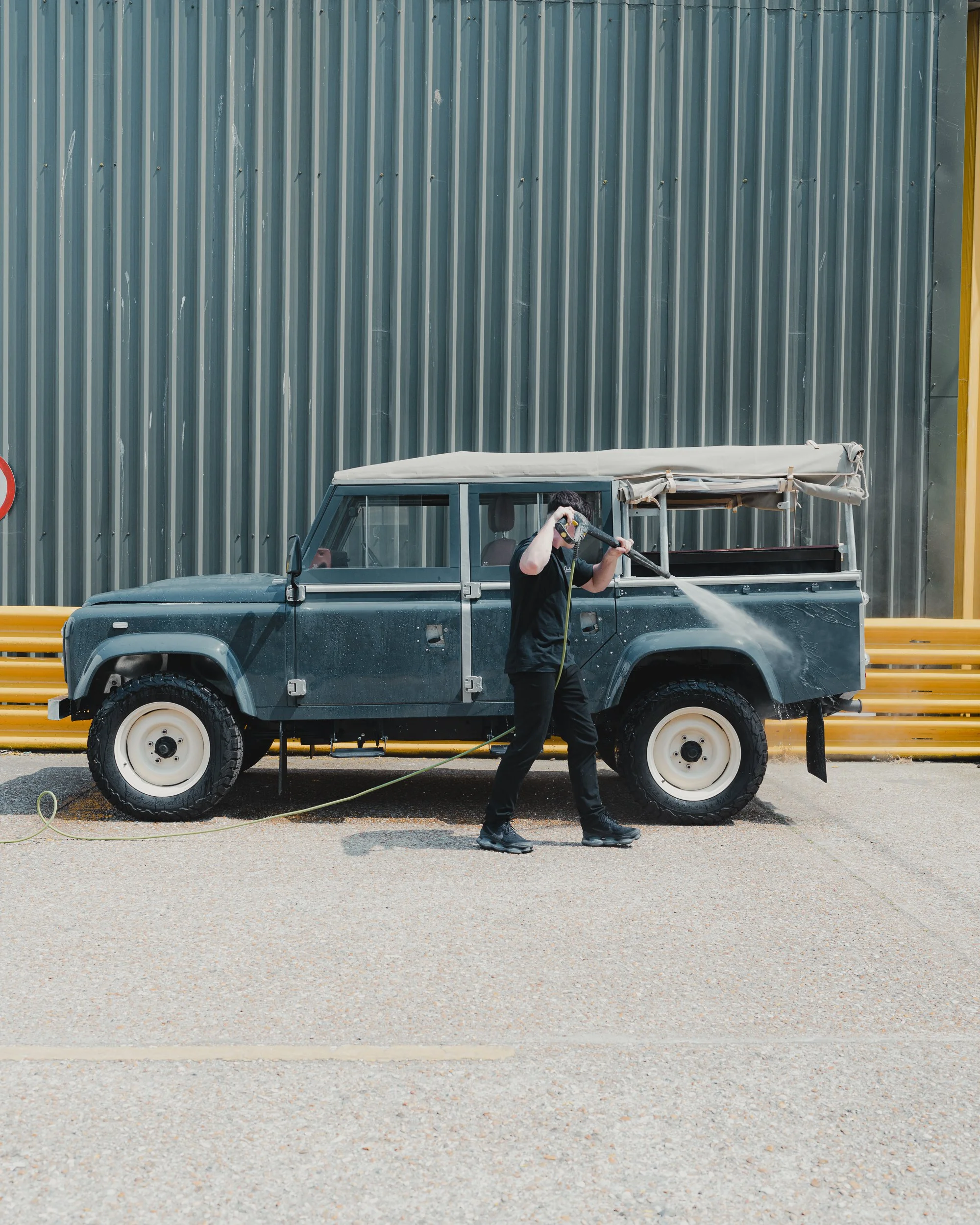
Rocky, a Defender 110 Beach in Slate Grey.
Heritage, Modern and Villain 110s can be built as a hard top or a soft top, and the Beach can be built with a hard top on request. Inside, every edition has a middle row and load bay seating, with rear air conditioning available as an option.
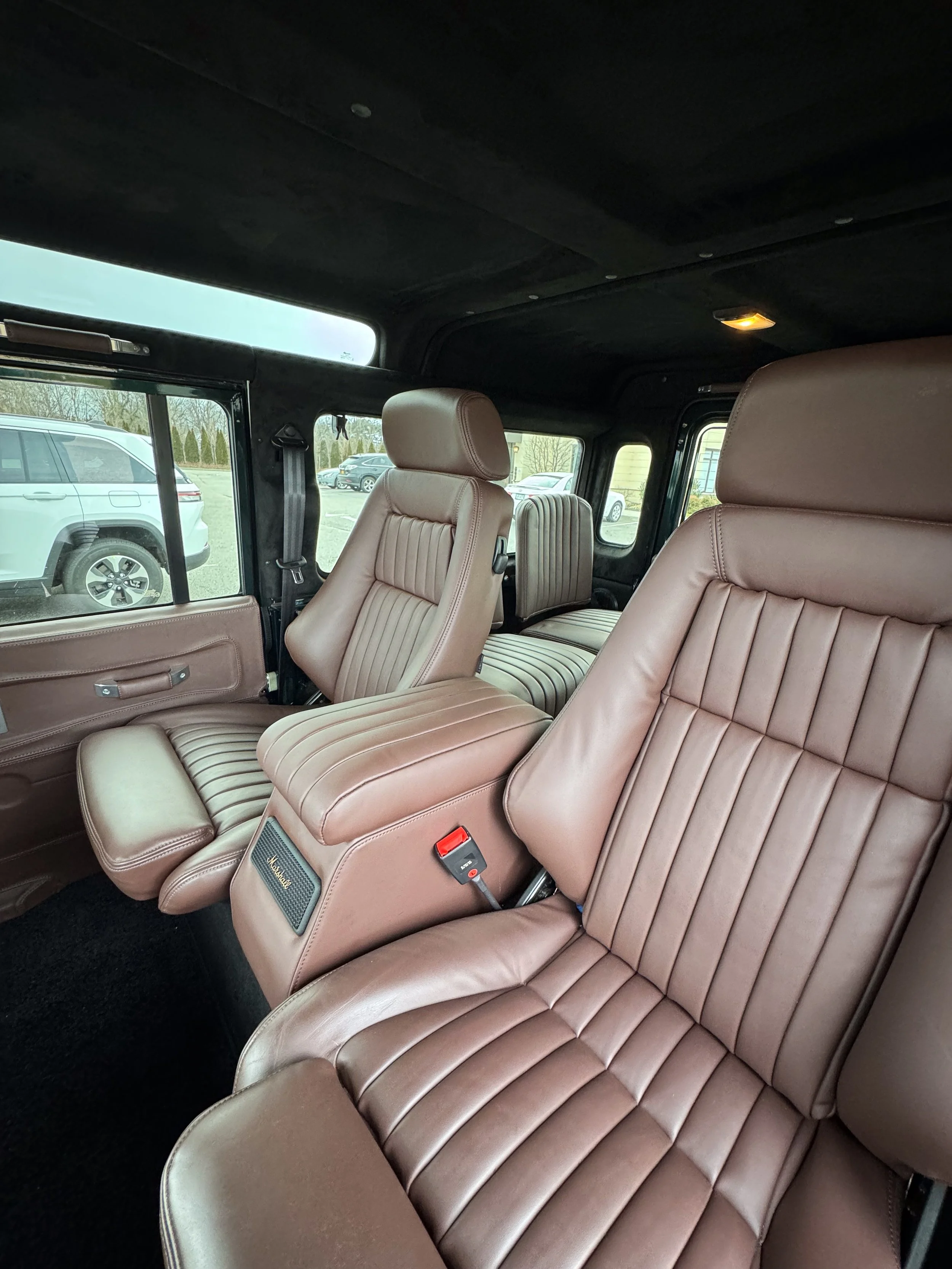
The leather cabin of a Defender 110 Modern.
How we build a Defender 110
Every Shoreline 110 begins with a genuine donor, sourced for the right year, the right body and the right starting condition. From there it goes through our nine-stage build process, with more than 3,000 hours of work in every truck.
- Chassis first. The truck is stripped to the bare chassis, which is inspected, strengthened, repaired where needed and treated against corrosion. On hard-worked Double Cabs we almost always fit a new chassis.
- A mechanically new truck. A new wiring loom, a rebuilt cooling system, a new fuel system, and rebuilt or replaced axles, differentials, brakes and suspension.
- A hand-built interior. Hand-stitched leather, modern gauges, climate control and premium audio, chosen from physical samples before the build starts.
- Proven before it leaves. A 24-hour systems inspection, a 500-mile road test and a 12-month warranty.
Builds typically take four to eight months, and you follow every stage through weekly photos in our online customer portal. See the full Shoreline build process, or browse finished trucks on our Defenders for sale page. If you want the classic shape with a contemporary finish, our custom Land Rover Defender Modern edition is a good place to start.
Frequently asked questions
A classic Defender 110 Station Wagon is 188.4 in (4,785 mm) long including the spare wheel on the back door. A 110 Pick Up or Double Cab Pick Up is 180.2 in (4,578 mm). Every 110 shares a 110 in (2,794 mm) wheelbase and is 70.5 in (1,790 mm) wide with the mirrors folded.
The long-wheelbase One Ten arrived in 1983 and was renamed the Defender 110 late in 1990, for the 1991 model year. The last classic Defender left the Solihull line on 29 January 2016.
A Defender 110 Station Wagon seats five as standard, with load bay seating that takes it to seven. The classic layout with inward-facing benches in the back can carry nine. Pick Up and Hard Top bodies seat two, and the Double Cab seats five.
No. The classic 110 is a body-on-chassis truck with a steel chassis and aluminum body, built from 1983 to 2016. The new Defender 110 has been on sale since 2020 and is a modern SUV on an aluminum monocoque platform. They share a name and not much else.
It depends on how you will use it. The LS3 V8 with a six-speed automatic is the most popular choice for highway and daily driving. A rebuilt 300 TDi or TD5 diesel suits Heritage and overland builds that keep the original character.
Our Defender 110 editions start from $135,000 for the Beach, $140,000 for the Heritage, $150,000 for the Modern and $200,000 for the Villain. The final price depends on the engine, finish and options you choose.
Thinking about a Defender 110?
Tell us how you plan to use it and who is coming along. We will talk through the body, the engine and the seating, and design a build around you.
GET IN TOUCH