

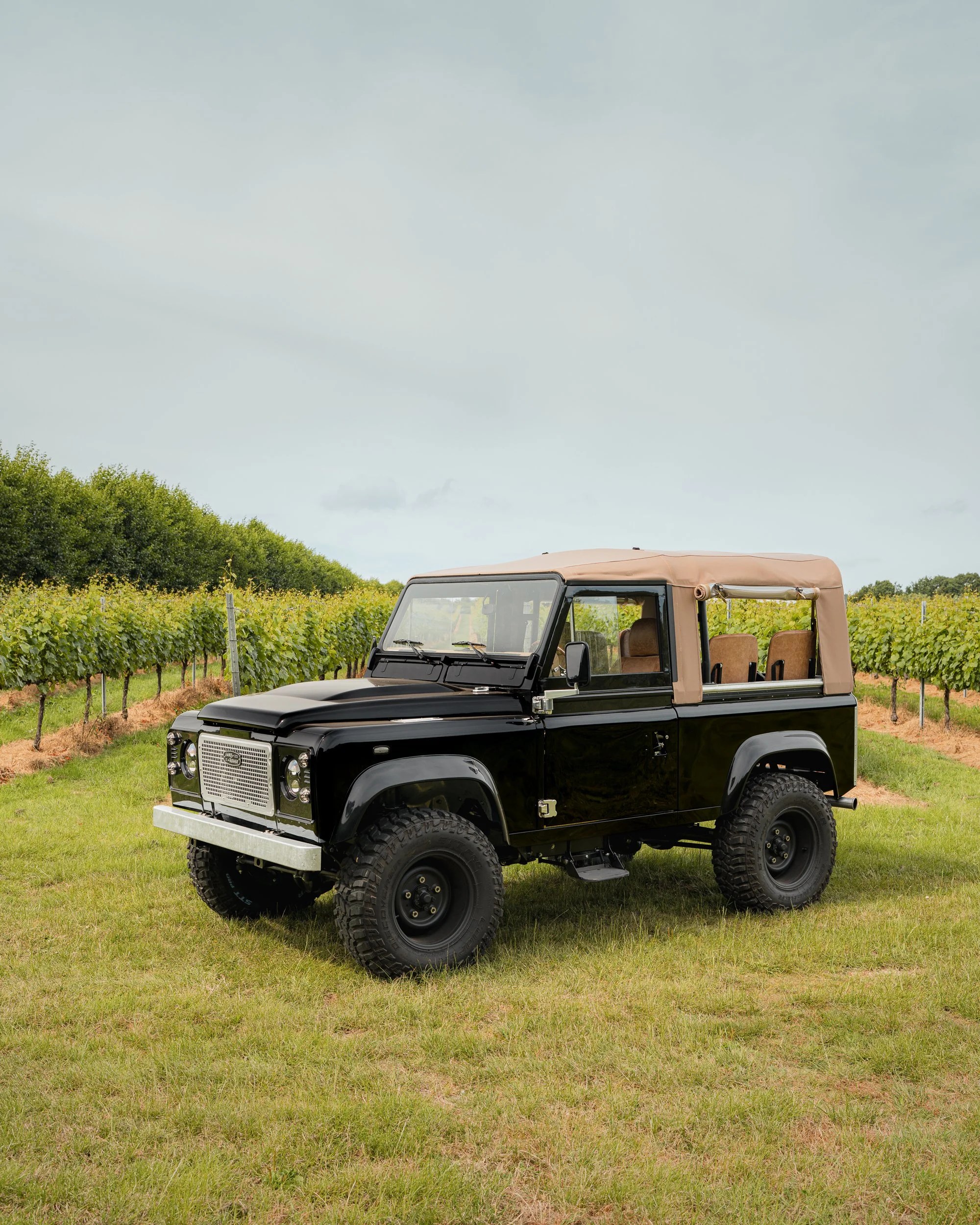
Almost every classic Defender on American roads came in from the UK or Europe. Here at Shoreline, we ship our builds from our UK workshop to clients across the US, so we deal with import rules every week.
This guide covers what actually decides whether a Defender can come into the country, the forms you need, what duty you will pay, and the mistakes that cost buyers time and money. It includes the real US Customs rulings on Defenders, so you can see how they have been classified.
The short answer
A Land Rover Defender can be imported into the USA once it is 25 years old, counted from its month of manufacture. At that age it is exempt from US federal safety standards. You declare it on NHTSA form HS-7 and EPA form 3520-1, and pay customs duty of either 2.5% or 25% of its value, depending on whether Customs treats it as a passenger vehicle or a truck.
Why can't you import a newer Defender?
Land Rover only sold the classic Defender in the US from 1993 to 1997, as the North American Specification (NAS) 110 and 90. Every other Defender was built for other markets and was never certified to US safety and emissions standards. Federal law does not allow a non-conforming vehicle onto US roads unless it is brought up to those standards, which is not realistic for a Defender.
The way in is the 25-year exemption. Once a vehicle is 25 years old, the National Highway Traffic Safety Administration (NHTSA) no longer requires it to meet US safety standards. That single rule is why so many classic Defenders can now be imported.
How the 25-year rule works
The age is counted from the vehicle's month and year of manufacture, not its model year or the year it was first registered. A Defender built in March 2001 becomes eligible in March 2026. Bring it in a month early and it can be refused entry or seized.
| Built in | Eligible for US import from | What that means |
|---|---|---|
| 1983 to 1990 | Already eligible | Early One Ten and Ninety, before the Defender name |
| 1990 to 1998 | Already eligible | 200Tdi and 300Tdi Defenders, the most popular donor trucks |
| 1998 to 2001 | Already eligible, month by month | Early Td5 Defenders are now coming of age |
| 2002 to 2006 | 2027 to 2031 | Later Td5 Defenders |
| 2007 to 2016 | 2032 to 2041 | Puma 2.4 and 2.2 Defenders, the last classic models |
The last classic Defender left the Solihull line in January 2016, so the final examples will not be eligible until January 2041.
The EPA's 21-year rule and why originality matters
Emissions are handled separately by the Environmental Protection Agency (EPA). A vehicle is exempt from EPA import rules once it is 21 years old, counted by production year, but only if it is in its original, unmodified configuration. A vehicle with a replacement engine does not qualify unless that engine and its emissions equipment are equivalent or newer EPA-certified parts.
This matters for restomods. An engine swap, such as a V8 in place of the original diesel, can take a Defender outside the EPA exemption, and some states, California above all, will not register a swapped vehicle unless the new engine meets their emissions rules. This is why the order of work and the paperwork have to be planned together on a custom build.
If you live in a state with strict emissions rules, ask any builder how their engine swap will be registered before you commit. We will talk you through how your spec affects registration where you live.
The paperwork: what you need at the port
Your customs broker files most of this, but you should know what each document is and keep copies. Your state's DMV will ask for several of them when you title and register the truck.
- NHTSA form HS-7. Declares that the vehicle is exempt from US safety standards because it is at least 25 years old.
- EPA form 3520-1. Declares the emissions exemption. Code E is used for vehicles at least 21 years old in original configuration.
- CBP form 7501 (Entry Summary). The customs entry, showing the tariff classification and duty paid. Keep the stamped or electronic copy.
- Bill of lading. Issued by the shipping line, it proves the vehicle was shipped to you.
- Proof of ownership. The foreign registration document, such as a UK V5C logbook, plus the bill of sale.
- Proof of build date. A heritage certificate or other record showing the month and year of manufacture is the strongest evidence for the 25-year rule.
Import duty: 2.5% or 25%?
This is the part most import guides skip, and it can be the most expensive. US Customs classifies a vehicle either as a passenger vehicle, with a duty rate of 2.5%, or as a vehicle for the transport of goods, with a rate of 25%. The higher rate is often called the chicken tax.
Customs decides by looking at how the vehicle is built, not what the seller calls it. Here is how it has ruled on real Defenders:
| Vehicle | Customs ruling | Duty | Why |
|---|---|---|---|
| 1996 Defender 110 2.5 TDi | N321296 | 2.5% | Four doors, built with rear seats, seat hardware still in place |
| 1985 Land Rover 110 | N315327 | 25% | Treated as a goods vehicle despite four doors and five seats |
| 1991 Defender 110 pickup | N301965 | 25% | Open cargo area, bench seats bolted to the load deck, barrier behind the cab |
| 1970 Land Rover Series 2A | N316612 | 25% | Diesel, rear designed for cargo with no passenger features |
The difference is large. On a vehicle declared at $100,000, the duty is $2,500 at 2.5% and $25,000 at 25%. Station Wagons with proper rear seating have the strongest case for the lower rate. Pickups, Hard Tops and vans are usually classed as trucks. Each entry is judged on the vehicle in front of Customs, so the past rulings above are a guide, not a guarantee.
Customs also charges small processing fees on every entry, and your broker, the port and the shipping line will each have their own charges.
Getting it registered in your state
Clearing Customs makes the truck legal to import. Registering it is up to your state. Most states will title an imported Defender with the documents above, a VIN inspection and an odometer disclosure, and many offer classic or antique registration once a vehicle reaches a certain age.
California is the hardest state. It applies its own emissions rules, and a 1975-or-later vehicle that was never certified for California can need extra testing and certification before it can be registered there. If you live in California, settle the registration route before you commit to a truck.
Is a right-hand drive Defender legal in the US?
Right-hand drive is legal in all 50 states, so a UK-market Defender does not need converting to drive or register. Most classic Defenders were built right-hand drive for the UK, and most US owners would rather sit on the left. For US clients, we convert to left-hand drive during the ground-up rebuild, rather than retrofitting a finished right-hand drive truck.
The mistakes that cost Defender buyers money
- Buying on model year instead of build date. A truck sold as a 2001 can have been built in 2000 or 2001. Only the build date counts.
- A swapped VIN or chassis. If the chassis number does not match the paperwork, the truck can be held or refused. A replacement chassis must be documented properly.
- Engine swaps done before shipping. As above, a non-original engine can cause problems with the EPA exemption.
- Assuming the 2.5% rate. Budget for 25% unless the truck is clearly a passenger vehicle.
- Forgetting your state. A Defender that clears Customs can still be hard to register in some states.
How Shoreline handles import for you
Every Shoreline Defender is built on a donor sourced from the UK and Europe that already qualifies for the 25-year rule. Here is what we handle so you do not have to:
- Sourcing: we find a donor with the right build date and clean paperwork.
- The build: a full ground-up rebuild across our UK and Miami workshops, including left-hand drive conversion for US clients.
- Compliance: EPA and DOT paperwork prepared before the truck ships.
- Shipping and customs: the truck is detailed, wrapped and shipped, then cleared through customs with our import partners.
- Delivery: from our Miami facility, the truck is detailed again, road-checked and handed over in person with the keys, the full build documentation and a 12-month warranty.
If you want a classic Defender in the US without dealing with any of the above yourself, that is exactly what we do.
If you are still deciding which truck to buy, read our used Land Rover Defender buyer's guide. For engine choices, see 300Tdi vs Td5 and our Defender V8 swap guide.
This guide explains how the rules generally work and is not legal or customs advice. Import rules, duty rates and state requirements change, so confirm the details for your vehicle with a licensed customs broker, NHTSA, the EPA and your state DMV.
Frequently asked questions
Yes, once it is at least 25 years old, counted from its month of manufacture. At that age it is exempt from US federal safety standards and can be imported legally.
Yes. Defenders sold new in the US from 1993 to 1997 are legal, and any other classic Defender is legal once it is 25 years old and imported with the correct paperwork.
Any Defender built 25 or more years before the month it arrives. During 2026 that means trucks built up to the same month in 2001.
Either 2.5% of the declared value if Customs classes it as a passenger vehicle, or 25% if it is classed as a goods vehicle. Station Wagons with rear seats have the best case for 2.5%. Pickups and Hard Tops are usually charged 25%.
NHTSA form HS-7, EPA form 3520-1, the CBP 7501 entry summary, the bill of lading, the foreign registration and bill of sale, and ideally proof of the build date.
Yes. Right-hand drive vehicles are legal to drive and register in all 50 states.
Want a Defender in the US without the paperwork?
Tell us what you are looking for. We will build it, ship it and handle the import, so it arrives ready to register.
GET IN TOUCH