

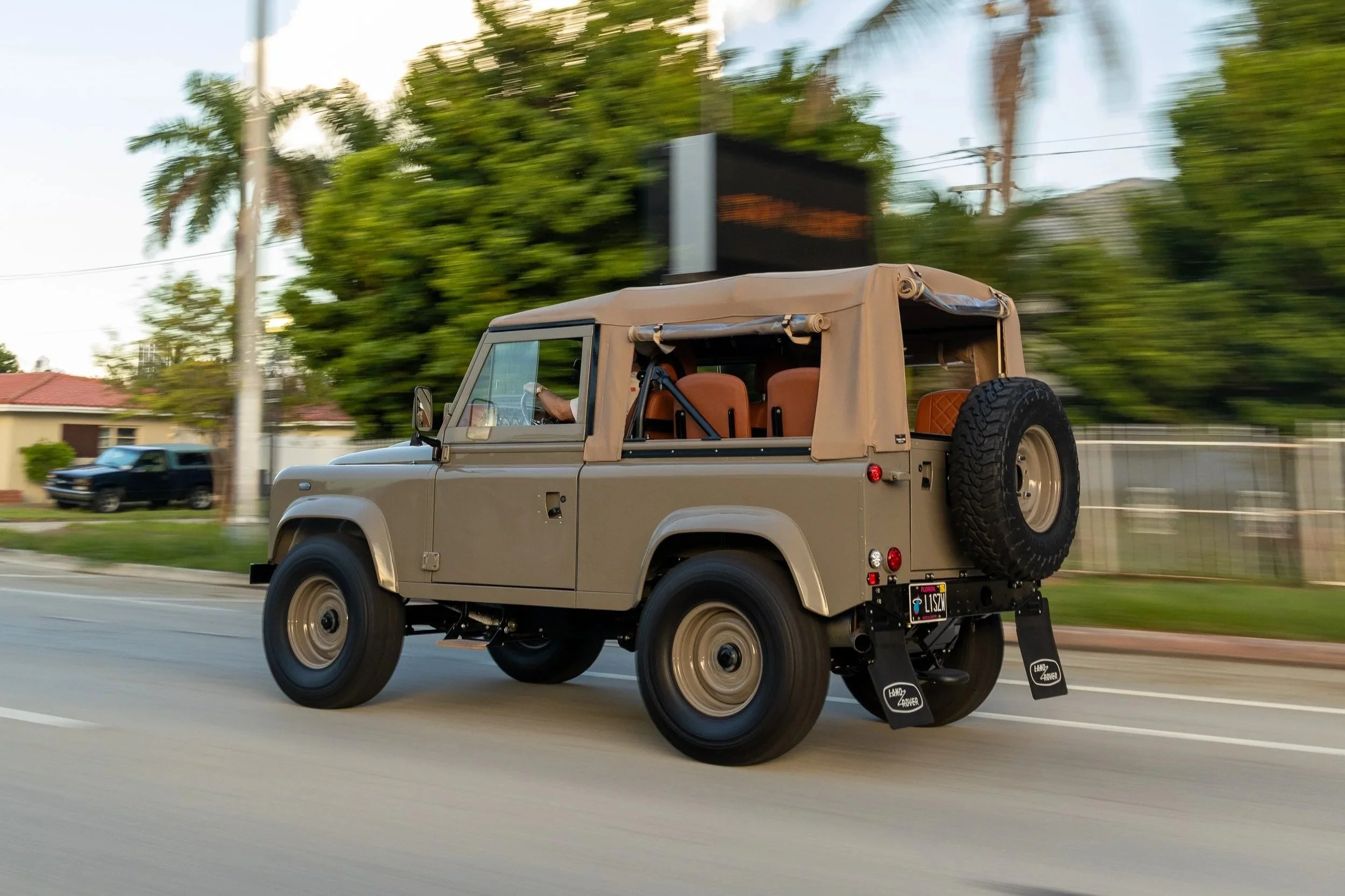
1990 is one of the most important years in the classic Land Rover's history. It is the year the Ninety and One Ten became the Defender, and the year Land Rover introduced the 200Tdi engine that made the vehicle genuinely usable on modern roads. It is also now more than thirty-five years old, which means every 1990 Defender on the market has a story, and not all of them are good ones.
This guide covers what makes a 1990 Defender different, which engines you will find, what typically fails, how to bring one into the US, and what a proper rebuild involves.
Why 1990 matters
Before 1990, the coil-sprung successors to the Series Land Rovers were sold as the Land Rover Ninety and One Ten. The Defender name arrived at the turn of the decade, when Land Rover needed to distinguish the utility vehicle from the Discovery, which launched in 1989.
The name change came alongside something more significant: the 200Tdi, a direct-injection turbodiesel that transformed how the vehicle drove. Earlier diesels were slow and struggled at highway speed. The 200Tdi gave the Defender enough torque to cruise comfortably, and it laid the foundation for the diesel engines Defender owners still value today.
That makes a 1990 vehicle a transition year. Depending on exactly when it was built, a "1990 Defender" can be badged as a Ninety or One Ten, or as a Defender, and it can carry an older engine or the new 200Tdi. Checking the chassis number and build date matters more for this year than almost any other.
1990 Defender engines
| Engine | What to Know |
|---|---|
| 200Tdi (2.5 turbodiesel) | The one most buyers want. Direct injection, strong low-down torque, simple to maintain and easy to find parts for. Introduced during this period, so not every 1990 vehicle has one. |
| 2.5 Diesel Turbo | The indirect-injection predecessor. Noticeably weaker and less durable than the Tdi. Often replaced during a rebuild. |
| 2.5 naturally aspirated diesel | Reliable but very slow. Fine for off-road use, hard work on a highway. |
| 3.5 V8 petrol | The Rover V8. Smooth and characterful, thirsty, and usually tired after three decades. Less common and sought after by collectors. |
| 2.5 petrol | The least common choice today. Adequate, but rarely the reason anyone buys a Defender. |
Most vehicles from this era used the LT77 five-speed manual gearbox, which was replaced by the stronger R380 a few years later. Many rebuilt 1990 Defenders now run an R380, a modern automatic, or a completely different drivetrain. Our LS3 V8 guide covers why that swap is the most popular choice for US builds.
Defender 90 or 110 from 1990
Both wheelbases were in production in 1990, along with the 127, the long-wheelbase variant that later became the 130.
The short-wheelbase Defender 90 is the more common restoration base in the US. It is compact and suits soft top and beach builds. The Defender 110 gives you four doors, more room, and better highway stability, and it is the better choice if the vehicle will carry passengers regularly.
What typically fails on a 1990 Defender
A 35-year-old Defender has had three and a half decades to rust, be modified, and be repaired by people of varying skill. The problems are predictable, which is the good news.
Chassis
The original chassis on a 1990 vehicle was not galvanized. Rear crossmembers, outriggers, and the rails ahead of the rear axle are the usual failure points. A chassis with structural rot needs replacing, and a new galvanized chassis is the standard fix on any serious rebuild.
Bulkhead
The steel bulkhead rots at the footwells, the door pillars, and along the top rail under the windscreen. It is expensive to repair and easy to disguise with paint and underseal.
Engine and gearbox
Pre-Tdi diesels are often worn out. Even a good 200Tdi will usually need timing belt, head gasket, and cooling attention. The LT77 gearbox is known for weak synchromesh on second gear.
Wiring and electrics
The original loom on a vehicle this age has almost always been cut into, extended, or repaired. Plan to replace it rather than chase faults one at a time.
Paperwork
Transition-year vehicles are the most likely to have mismatched badging, replaced engines, or unclear history. Verify the chassis number against the documents and confirm what engine the vehicle left the factory with.
For a fuller inspection checklist that applies to any classic Defender, see our vintage Land Rover Defender buyer's guide and our article on how reliable a Land Rover Defender really is.
Buying a 1990 Defender in the US
The Defender was not sold new in the US in 1990. Every 1990 Defender in the country was imported later, usually under the rule that allows vehicles 25 years or older to be imported without meeting modern federal safety and emissions standards.
A 1990 vehicle comfortably qualifies, but importing still involves customs, documentation, and state-level registration. In states with strict emissions rules, what engine is fitted can affect whether the vehicle can be registered at all. Our guide to importing a Land Rover Defender to the US walks through the process.
What a 1990 Defender costs
Prices for 1990 Defenders vary more than for almost any other year, because condition varies more. An original vehicle with a tired engine and hidden chassis rot can look similar in photos to one that has been properly restored, and cost a fraction of the price for good reason.
The real cost of a cheap 1990 Defender is what it takes to make it right: a chassis, a bulkhead, a rebuilt or replaced drivetrain, new wiring, and paint. Our Defender restoration cost guide breaks those numbers down, and our guide to buying a Land Rover Defender compares used, restored, and built from scratch.
Rebuilding a 1990 Defender properly
A 1990 vehicle makes an excellent donor for a ground-up build. It has the classic proportions, the pre-Puma dashboard, and the period details people want, and every weakness listed above is fixable when the vehicle is stripped to a bare chassis.
At Shoreline, that means a galvanized chassis, a repaired or replaced bulkhead, a rebuilt or upgraded drivetrain, new wiring throughout, Range Rover-standard paint, and a hand-finished interior, carried out through our nine-stage build process. A build like this typically takes four to eight months, and we explain why in how long a Defender restoration takes.
If you want the vehicle to keep its original character, our Defender 90 Heritage and Defender 110 Heritage editions are built for exactly that. If you want a modern drive in a period body, the difference between the two approaches is covered in restoration versus restomod.
1990 Land Rover Defender FAQs
Is a 1990 Land Rover Defender reliable?
An original one is only as reliable as its last rebuild. A properly restored 1990 Defender with a sound chassis, fresh wiring, and a rebuilt 200Tdi or modern engine is dependable enough to use every day.
Is a 1990 Defender legal to import to the US?
Yes. It is well past the 25-year threshold, so it can be imported without meeting current federal standards. State registration and emissions rules still apply.
What engine did the 1990 Defender have?
It depends on the build date and specification. Options included the 200Tdi, the earlier 2.5 Diesel Turbo, a naturally aspirated 2.5 diesel, the 2.5 petrol, and the 3.5 V8.
Is a 1990 Defender a good investment?
We do not make promises about resale values. Well-documented vehicles with professional, ground-up rebuilds have historically held value far better than neglected or poorly restored examples.
The bottom line
A 1990 Land Rover Defender sits at the point where the classic vehicle gained its name and its best engine. That makes it one of the most appealing years to own, and one of the most important to check carefully. Confirm the chassis number and engine, inspect the chassis and bulkhead properly, and budget for what a vehicle this age really needs.
If you want 1990 character without 1990 problems, a ground-up build removes the guesswork. Browse our builds or talk to us about yours.
Looking for a 1990 Defender?
Tell us how you want to use it and what you want it to look like. We will talk you through donors, builds, and what they cost.
GET IN TOUCH