

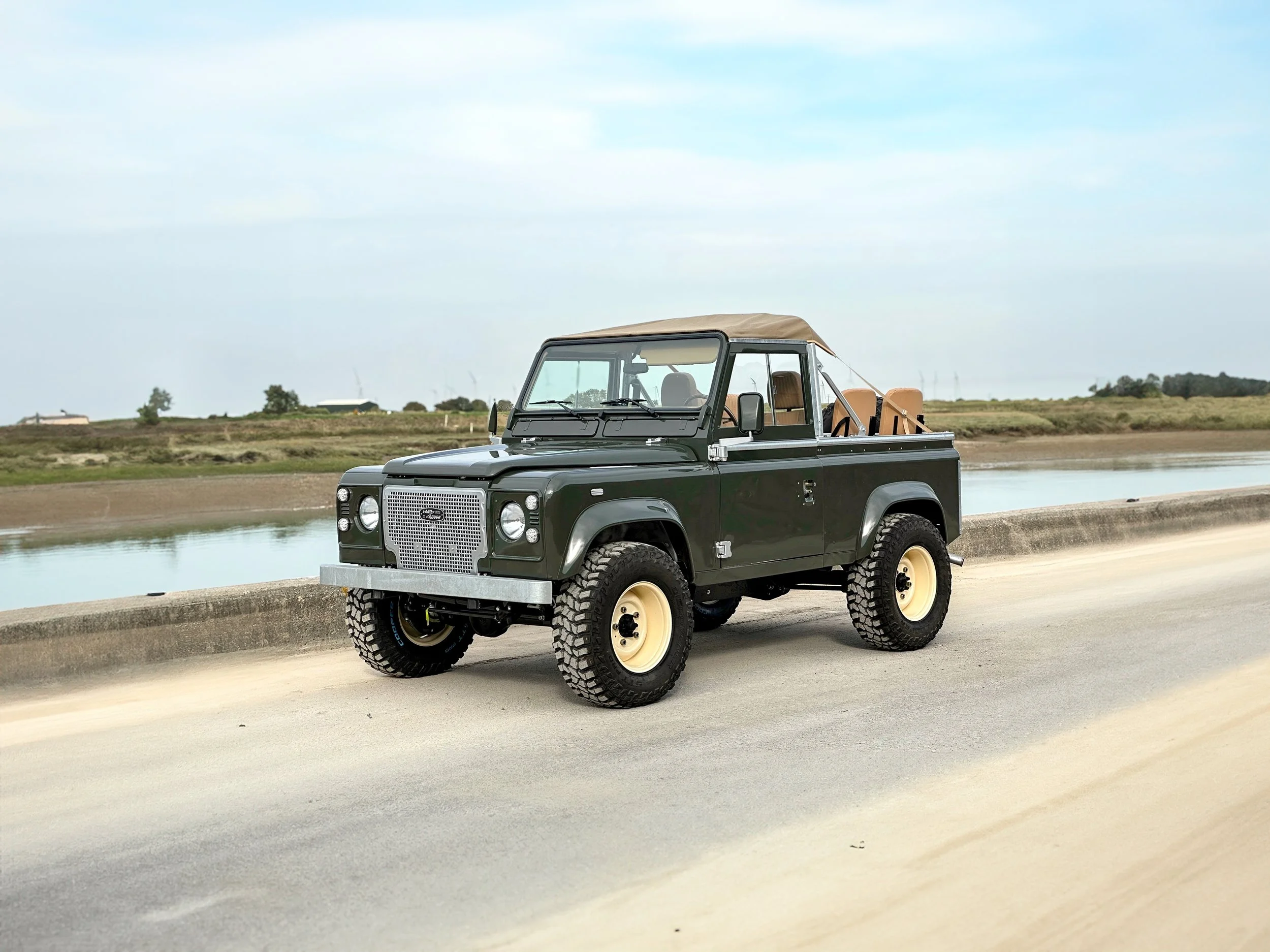
Vintage Land Rover Defender: Years, Values and How to Buy One
"Vintage Defender" covers more than thirty years of production. A 1985 One Ten and a 2005 Defender 110 share a shape, but almost nothing else. The engine, gearbox, dashboard, seating and even the badge on the grille changed several times along the way, and each change affects how the truck drives, what it is worth and whether it can come into the US.
Every Shoreline build starts with a vintage Defender, and our donors run from the mid-1980s to the early 2000s. This guide walks through each era, explains why 1990 is the most confusing year of all, covers what actually makes one vintage Defender more desirable than another, and sets out how to buy and restore one without expensive surprises.
The short answer
A vintage Land Rover Defender usually means a classic Defender built before the 2007 Puma update: the Ninety and One Ten (1983 to 1990), the 200Tdi (1990 to 1994), the 300Tdi (1994 to 1998) and the Td5 (1998 to 2006). The 300Tdi years are the most sought after for their simple mechanical diesel. Condition, originality and paperwork drive value far more than the exact year, and any truck at least 25 years old, counted from its month of manufacture, can be imported to the US.
| Era | Years | Main engines | What changed |
|---|---|---|---|
| Ninety and One Ten | 1983 to 1990 | 2.25 and 2.5 gasoline, 2.5 diesel, 2.5 Diesel Turbo, 3.5 V8 | Coil springs and permanent four-wheel drive replace the Series layout |
| Defender 200Tdi | 1990 to 1994 | 200Tdi, 2.5 turbodiesel107 bhp | Defender name, first direct-injection diesel |
| Defender 300Tdi | 1994 to 1998 | 300Tdi, 2.5 turbodiesel111 bhp | R380 gearbox, discs on all four wheels |
| Defender Td5 | 1998 to 2006 | Td5, 2.5 five-cylinder122 bhp | Electronic engine management, one-piece rear door from 2002 |
| Defender Puma | 2007 to 2016 | 2.4, then 2.2 Ford diesel122 bhp | Full-width dashboard, six-speed gearbox, forward-facing rear seats |
What counts as a vintage Land Rover Defender?
There is no official cut-off. Most people searching for a vintage, old or antique Land Rover Defender mean the original utility truck, built at Solihull from 1983, before Land Rover gave it a full-width dashboard and a Ford engine for 2007. That covers the 1980s Ninety and One Ten, the Tdi trucks of the 1990s and the Td5. Some buyers also include the leaf-sprung Series Land Rovers that came before it, which we compare in our Series vs Defender 90 guide.
The classic Defender came in three wheelbases: the short Ninety, later the Defender 90; the long One Ten, later the Defender 110; and the extra-long 127, later the Defender 130. Each was offered in several bodies, from soft tops and pickups to Hard Tops and Station Wagons. When people picture a vintage Defender, it is usually a 90 soft top or a 110 Station Wagon.
1983 to 1990: the Ninety and One Ten
The classic Defender did not start life as a Defender. The long-wheelbase One Ten arrived in 1983 and the short-wheelbase Ninety followed in 1984. They replaced the leaf-sprung Series III with coil springs and permanent four-wheel drive, and they are the trucks that set the shape everyone now calls a Defender.
Early trucks used the 2.25 gasoline and diesel, then a 2.5 diesel from 1984 and a 2.5 gasoline engine from 1985. The 3.5 Rover V8 was offered in the One Ten from the start and in the Ninety from 1985, and from 1986 a 2.5 Diesel Turbo joined the range. None of these is fast by modern standards. The diesels in particular were built for fields, not freeways.
This is the era for anyone who wants the oldest, most original 1980s Defender character: the "Ninety" and "One Ten" badging, the simple dashboard and the starting-handle hole in the front bumper. Several of our Beach builds start from this era, because the early trucks wear a soft top so well.
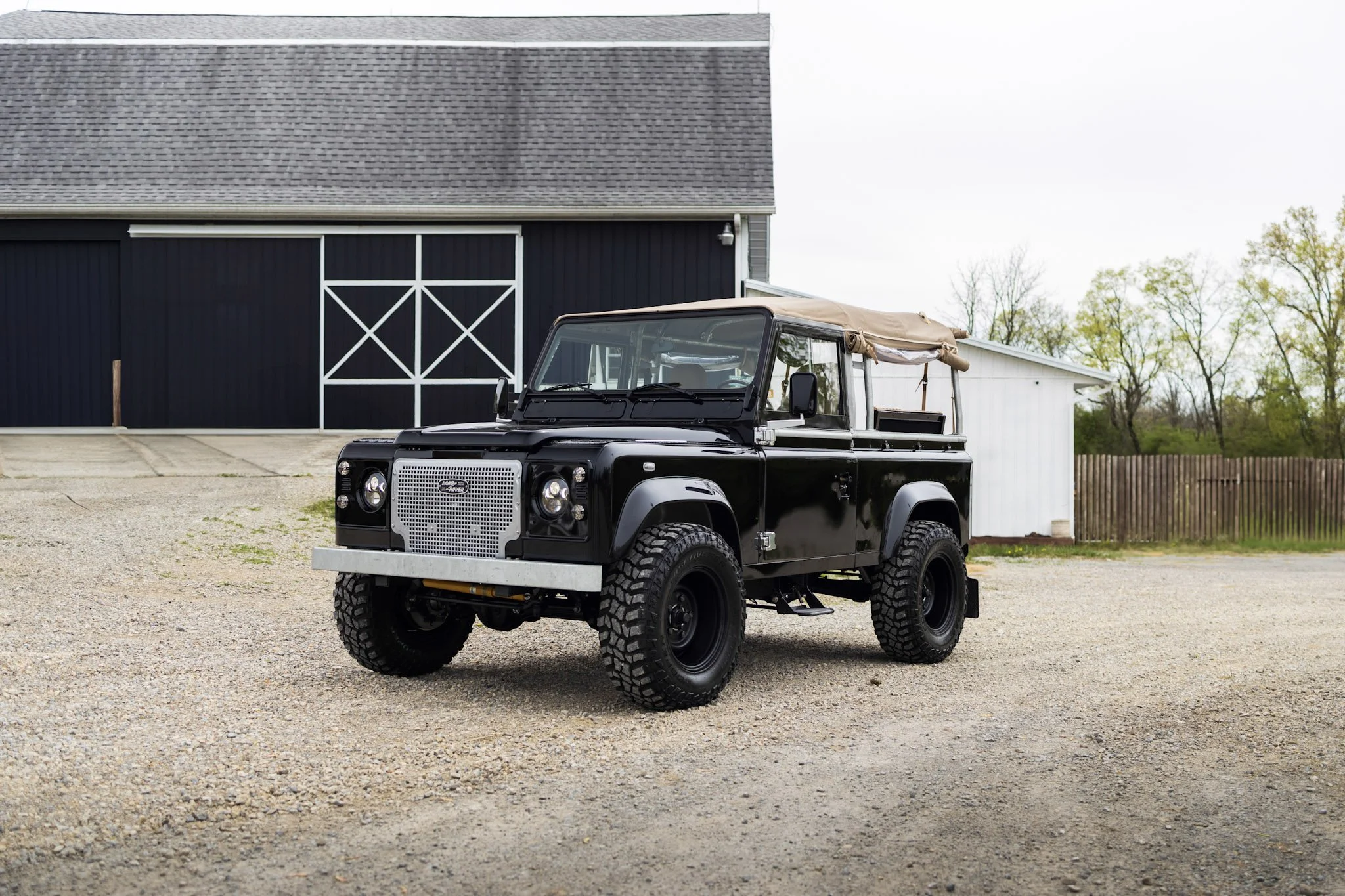
Drifter, a Defender 90 Beach we built on a 1986 Ninety.
If you buy an original from this era, expect it to need the most work. These trucks are now around forty years old, the original engines are slow, and the chassis has had the longest to rust. As a donor for a full rebuild, though, age matters far less than condition, and an early truck with sound metalwork is a very good place to start.
The 1990 Land Rover Defender: the year it got its name
Land Rover launched the Discovery in 1989 and needed a name to tell its utility vehicle apart. Late in 1990, for the 1991 model year, the Ninety and One Ten became the Defender 90 and 110, and the 127 became the 130.
The name arrived with something more important: the 200Tdi, the direct-injection turbodiesel from the Discovery. That makes 1990 a true transition year. A truck sold as a 1990 Land Rover Defender can carry Ninety or One Ten badges or Defender badges, and an older engine or the new 200Tdi, depending on when it was built.
If you are looking at a 1990 truck, three checks matter more than the ad:
- The build date. Check the chassis number and build date against the title or registration. It tells you which side of the change the truck falls on.
- The engine. A 200Tdi is the more useful engine on the road. An earlier 2.5 diesel or Diesel Turbo is more original to a pre-Defender truck, but slower.
- The badges. Badges are easy to swap. Treat them as a clue, not proof, and let the paperwork and the engine number settle it.
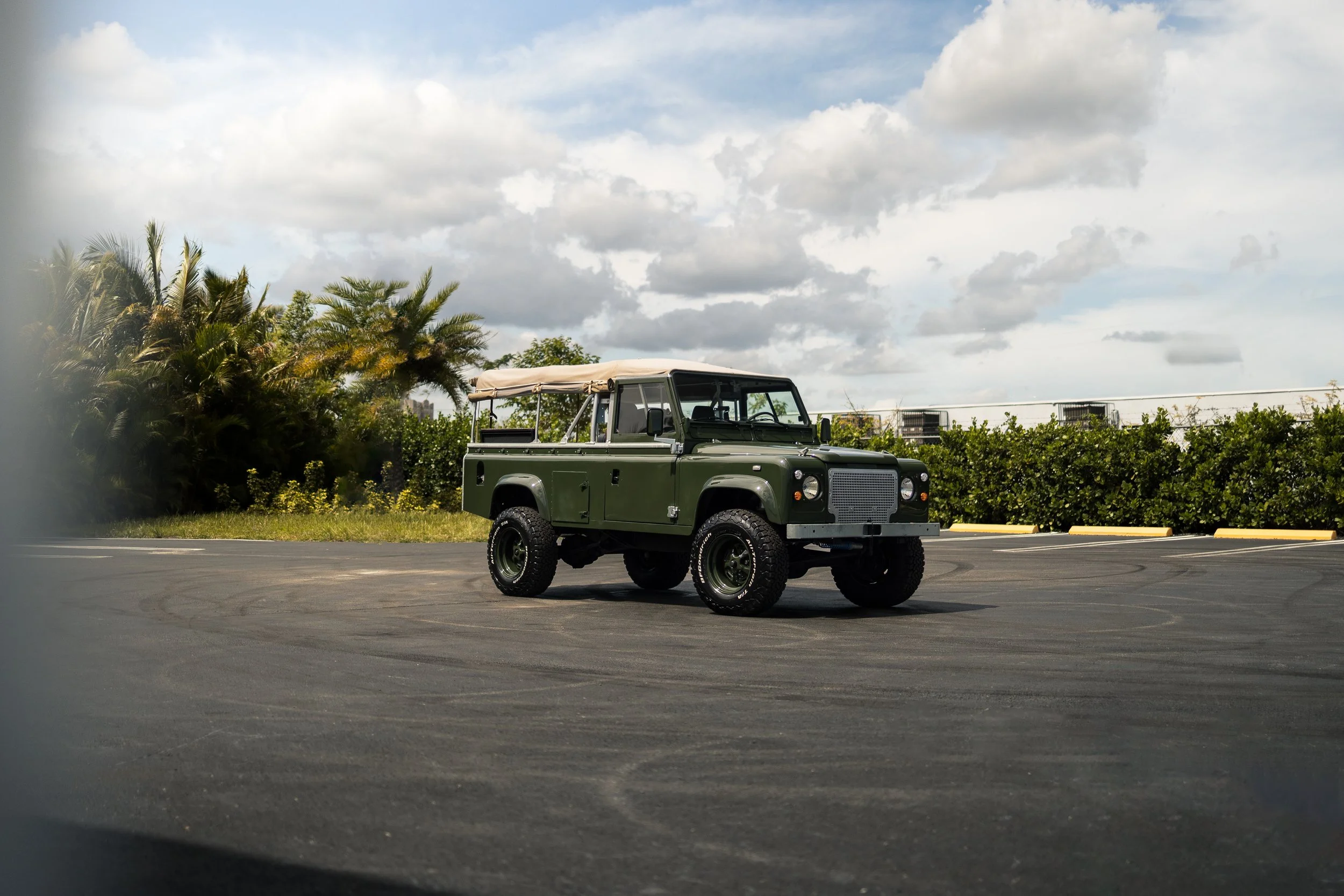
A 1990 Defender 110 soft top restored through our Restoration Lab in Miami.
For a US buyer, any 1990 Defender is long past the 25-year mark, so import eligibility is not a question. The question is simply which truck you are buying.
1990 to 1994: the 200Tdi
The 200Tdi changed how the Defender drove. Earlier diesels struggled to hold highway speed. The 200Tdi made 107 bhp and 195 lb-ft of torque, low in the rev range, and it gave the Defender enough pull to cruise comfortably for the first time.
The rest of the truck changed in small steps. Power steering was optional for 1991 and standard from 1992. The older four-cylinder engines were gone for 1992, the starting-handle hole disappeared the same year, and the 3.5 V8 was dropped around the same time in most markets. Every truck used the LT77 five-speed gearbox, improved in 1992, with disc brakes at the front and drums at the rear.
Early Tdi Defenders are simple, mechanical and well loved. They are rarer than the later 300Tdi trucks, and a good one with its original engine is worth looking after.
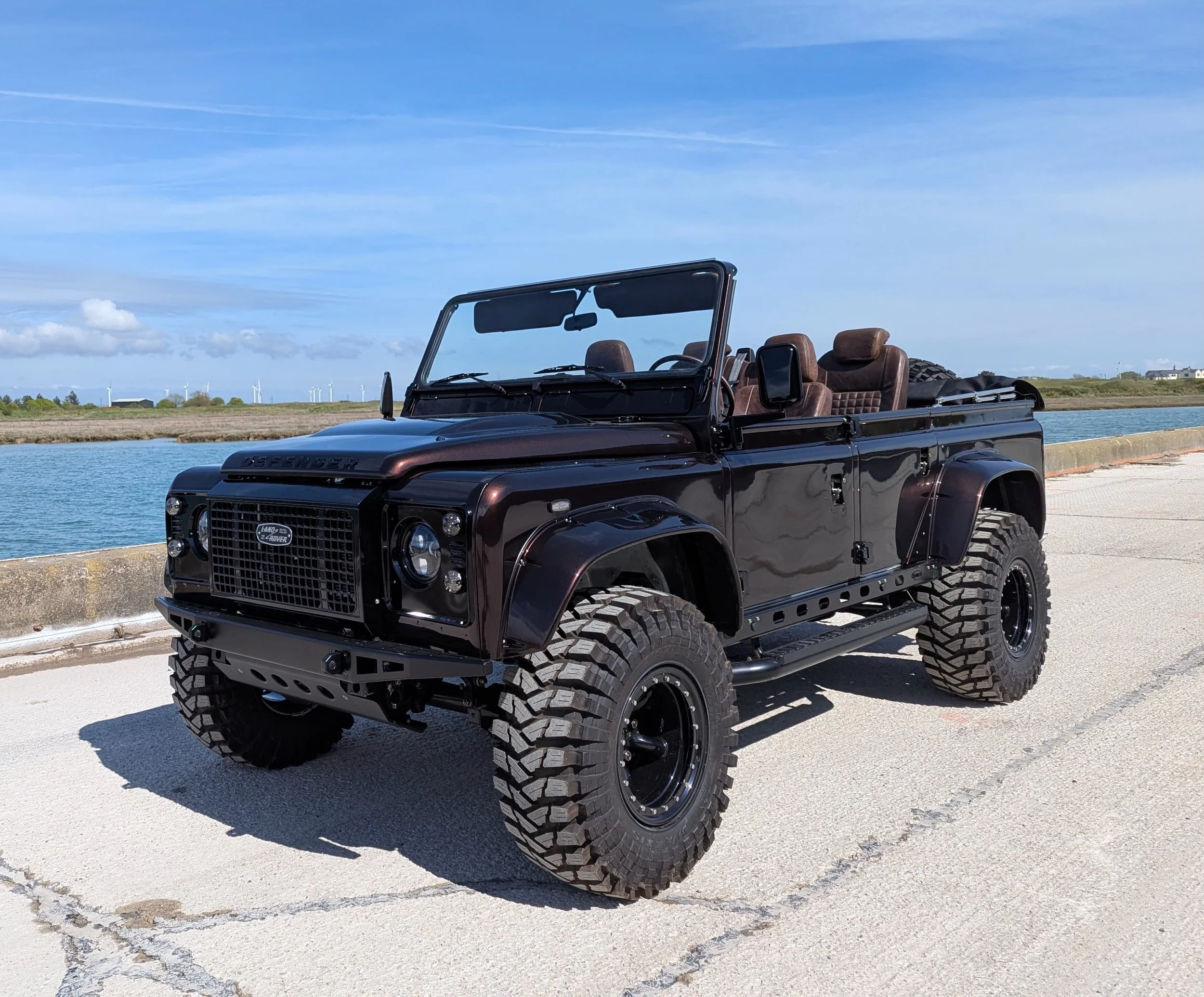
Goldeneye, a Defender 110 Villain soft top we built on a 1993 donor.
1994 to 1998: the 300Tdi
From March 1994 the 300Tdi replaced the 200Tdi. It is still a 2.5-liter, four-cylinder turbodiesel, now with 111 bhp. It arrived with the stronger R380 five-speed gearbox, and the Defender gained disc brakes on all four wheels.
For many owners this is the high point. The 300Tdi is the last purely mechanical Land Rover diesel. There is no engine computer, and any competent workshop can keep one running with hand tools. That is why 300Tdi trucks are the most sought-after donors for builds that keep a diesel. Our 300Tdi vs Td5 guide covers the engine in detail.
This era also includes the only Defenders sold new in the US: about 500 NAS Defender 110s in 1993, then NAS Defender 90s for 1994, 1995 and 1997, all with Rover V8 gasoline engines. They are rare and collectible in their own right.
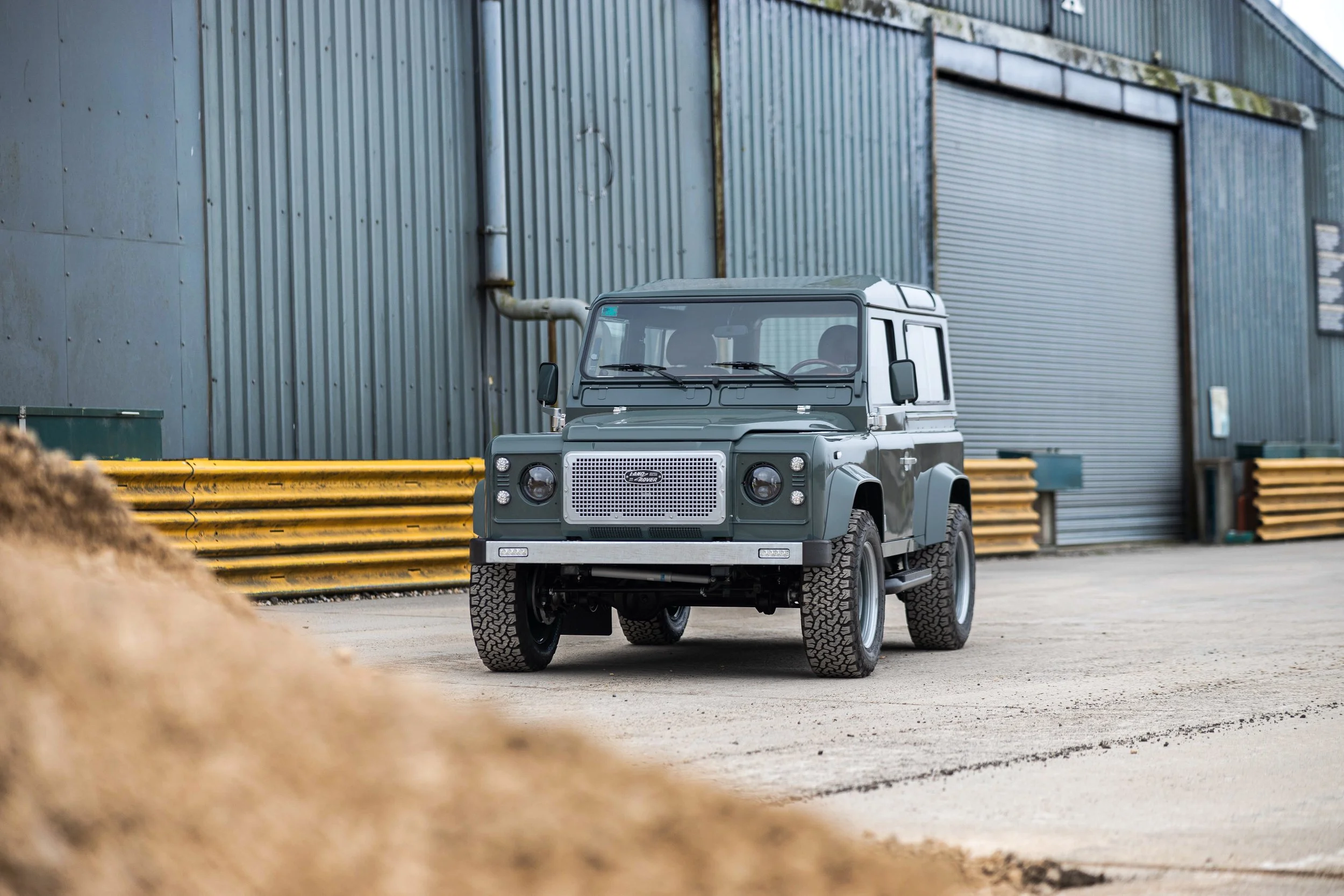
Cole, a Defender 90 Heritage we built on a 1996 donor.
1998 to 2006: the Td5
The Td5 replaced the 300Tdi for the 1999 model year. It is a 2.5-liter, five-cylinder turbodiesel with 122 bhp and electronically controlled injectors. It is smoother, quieter and stronger than the Tdi, and much better at highway speed. The trade-off is electronics: when a Td5 has a problem, it usually needs a diagnostic computer to find it.
Other changes came with it: a strengthened R380 gearbox, electronic instruments, and optional ABS, traction control and air conditioning. The 2002 model year brought a one-piece rear door and central locking as standard.
Td5 Defenders are the newest trucks that can be imported to the US today, and the window is moving through 2001 builds one month at a time. If you want a vintage Defender that is easier to live with on modern roads, this is the era to look at.
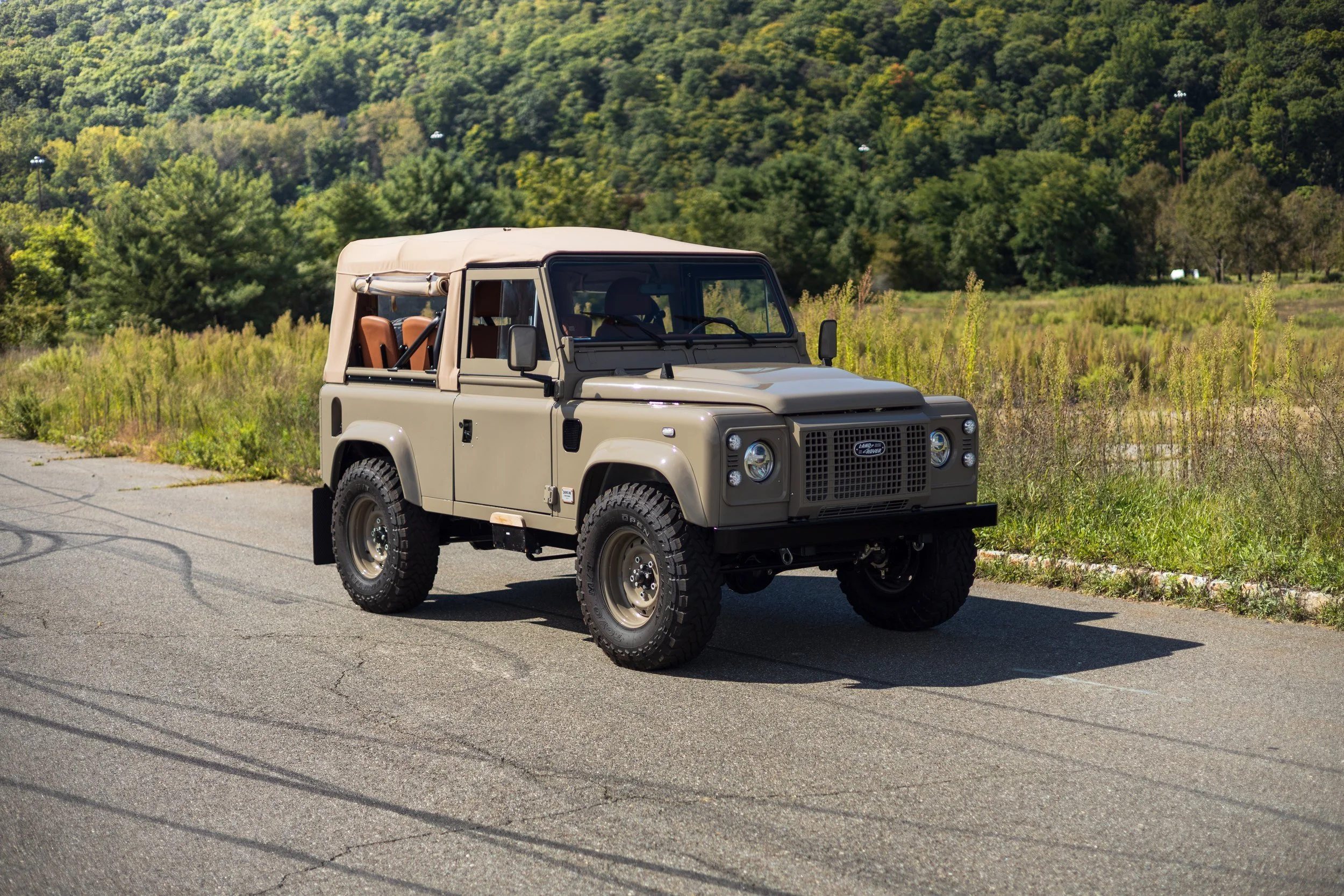
Dune, a Defender 90 Beach we built on a 2000 Td5.
For 2007 the Td5 gave way to the Ford-based Puma, with a full-width dashboard, a six-speed gearbox and forward-facing rear seats. Puma trucks are the most comfortable classic Defenders but the least vintage in feel, and in the US they will not reach 25 years old until 2032 onwards.
What makes a vintage Defender valuable?
Two trucks of the same year can be worlds apart in value. The year sets the starting point. These are the things that move it.
- Chassis and bulkhead condition. The steel chassis and the steel bulkhead behind the engine are where Defenders rust, and both are major jobs to put right. A truck with sound metal is worth far more than a shiny one hiding rot.
- Originality. For collectors, original engine, badges and body style matter. An early One Ten V8 or a NAS truck with its original specification is valued for exactly that.
- Paperwork. A chassis number that matches the title, a documented build date and a service history all add value and make import and registration simpler.
- Engine and gearbox. A healthy 300Tdi or Td5 is easier to sell and easier to live with than a tired early diesel.
- Body style. 90 soft tops and 110 Station Wagons tend to be the most wanted. Pickups and Hard Tops can also affect how the truck is classified for US import duty.
- The quality of any restoration. A properly documented, ground-up rebuild is worth more than a cosmetic refresh, because the expensive parts of the truck have been dealt with.
Supply matters too. Production ended in January 2016, every year the pool of good original trucks gets smaller, and our article on why the Defender was discontinued explains why there will not be any more of them.
How to buy a vintage Land Rover Defender
Most vintage Defenders for sale in the US have already been imported, but many buyers still look at trucks in the UK and Europe, where most were sold. Wherever the truck is, the same checks apply.
Check the metalwork first
Look under the truck before you look inside it. On the chassis, check the rear crossmember, the outriggers and the area around the spring mounts. On the body, check the bulkhead footwells and door pillars, and the steel door frames. The aluminum body panels resist rust, but they can corrode where they meet steel.
Match the numbers
Check the chassis number on the truck against the title or registration, and note the engine number. Engines get swapped, badges get changed, and a truck sold as one year can easily be another. A replacement chassis is not a problem in itself, as long as it is properly documented.
Know which engine you want
A Tdi is simple and can be repaired almost anywhere. A Td5 is smoother but more electronic. If you plan a restomod, the original engine matters less, and many clients choose a new drivetrain such as an LS3 V8 from our engine options.
Confirm it can be registered where you live
For a US buyer, the build date decides import eligibility, and your state decides registration. Our guide to importing a Land Rover Defender to the USA explains the 25-year rule, the forms and the import duty. Our used Defender buyer's guide has the full inspection checklist.
Restoring a vintage Defender
There are two ways to bring an old Defender back. A restoration returns it to how it left the factory, with the original engine and character. A restomod keeps the classic look but renews and upgrades the drivetrain, suspension, brakes, wiring and interior so it drives like a modern vehicle. Our restomod vs restoration guide compares the two in detail.
Either way, a proper job starts at the chassis. In our build process, every donor is stripped to the bare chassis, inspected, strengthened and treated for corrosion before anything is built back on top. The entire wiring loom is replaced, not patched, because an old harness is one of the most common failure points on a classic Defender. Axles, differentials and brakes are rebuilt or replaced, the body is refinished by hand, and every truck finishes with a 500-mile road test.
Which edition you choose shapes the rest. Our Heritage edition keeps the original character with a rebuilt diesel, Beach builds are open soft tops, Villain is darker and lifted, and Modern is our most contemporary finish. If you already own a vintage Defender in the US, our Miami Restoration Lab offers refurbishment as well.
Which vintage Defender is right for you?
There is no single best year. It depends on what you want the truck to be.
- The most original character: a Ninety or One Ten from the 1980s. The oldest look and the simplest truck, best rebuilt with a stronger drivetrain if you plan to drive it often.
- A diesel you can fix anywhere: a 300Tdi from 1994 to 1998. The most popular donor for good reason.
- The easiest to live with: a Td5. Smoother and quieter, and old enough to import to the US.
- A collector's piece: a NAS Defender, sold new in the US in the 1990s.
If you plan a full rebuild, the era matters less than you might think. Once a truck is stripped to the chassis, almost everything can be renewed or upgraded. What matters most is a solid starting point. You can see finished builds in our cars, and trucks ready to buy on our Defenders for sale page.
Frequently asked questions
What year is considered a vintage Land Rover Defender?
There is no official cut-off, but most people mean a classic Defender built before the 2007 Puma update, from the 1983 Ninety and One Ten through to the Td5. Some also include the Series Land Rovers that came before it.
Is a 1990 Land Rover Defender a Defender or a One Ten?
It can be either. The Ninety and One Ten became the Defender 90 and 110 late in 1990, for the 1991 model year, so a 1990 truck can carry either badge and either an older engine or the 200Tdi. Check the build date and engine number.
Which Defender years are most sought after?
The 300Tdi trucks from 1994 to 1998 are the most popular, for their simple mechanical diesel. Early Ninety and One Ten trucks are valued for their originality, and the NAS Defenders sold new in the US are rare and collectible.
What affects the value of a vintage Defender?
Chassis and bulkhead condition first, then originality, matching paperwork, the engine, the body style and the quality of any restoration. A sound truck with clean paperwork is worth more than a cosmetically better one with hidden rust.
Can I import a vintage Defender to the US?
Yes, once it is 25 years old, counted from the month it was built. Every Ninety, One Ten, 200Tdi and 300Tdi truck is now old enough, and Td5 trucks are becoming eligible month by month. Puma Defenders will not qualify until 2032 onwards.
Should I restore a vintage Defender or build a restomod?
Restore it if originality matters most to you. Choose a restomod if you want to drive it often, on highways, with modern brakes, comfort and reliability. Both should start with a properly rebuilt chassis.
Looking for a vintage Defender?
Tell us which era you like and how you want to use it. We will find the right donor and build it around you.
GET IN TOUCH